Planetary Nebula
An expanding shell of ionized gas ejected from a red giant star in the late stages of stellar evolution. Despite the name, it has no connection to planets. The glowing gas is illuminated by the hot core of the dying star.
Source: science.nasa.gov
APODs including "Planetary Nebula"
Shapley 1: An Annular Planetary Nebula
04/03/2026
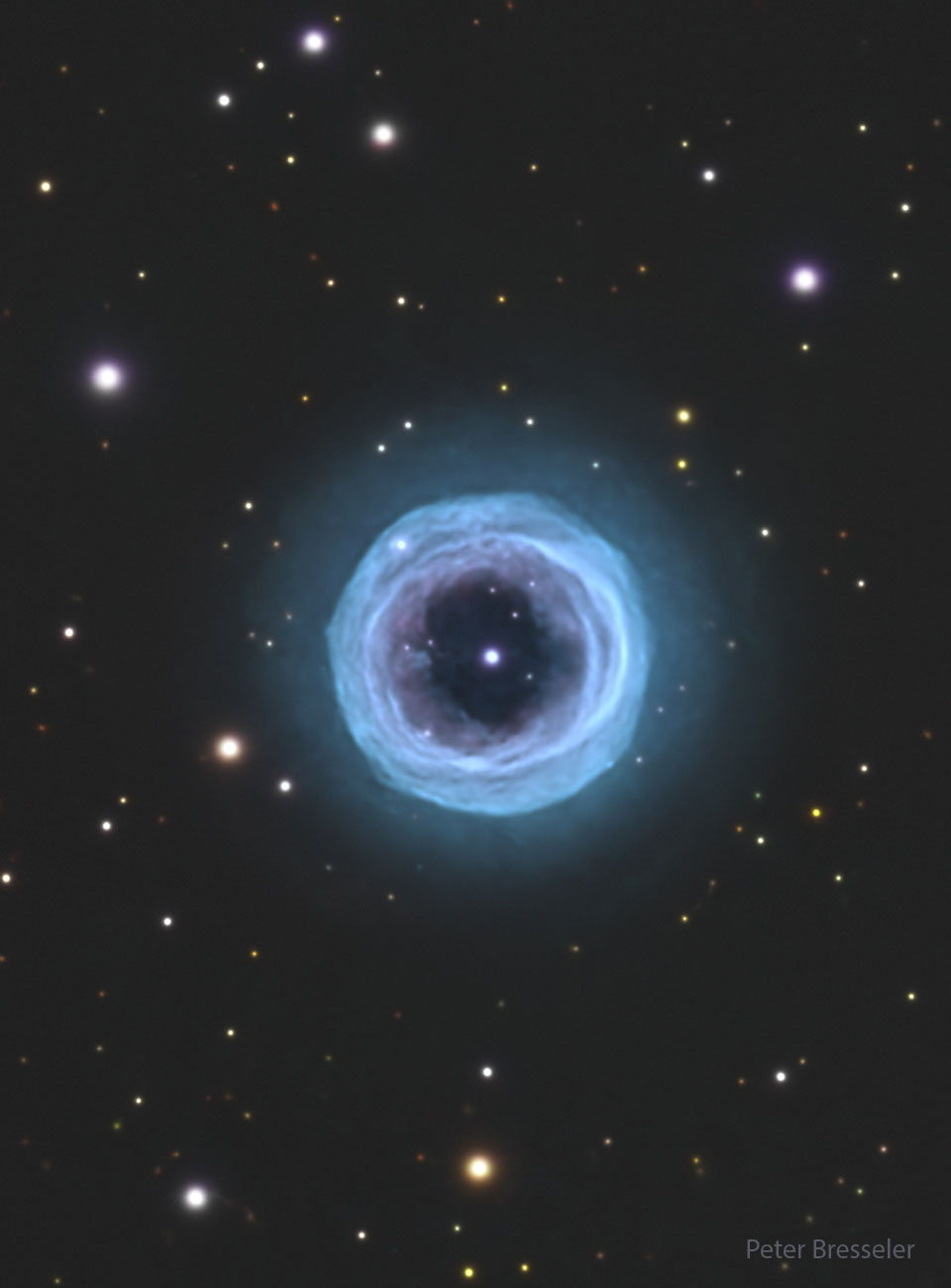
What’s looking back at you isn’t a cosmic eye, but Shapley 1, a beautifully symmetric planetary nebula. Shapley 1, also known as the Fine Ring Nebula or PLN 329+2.1, bejewels the southern sky constellation of the Carpenter's Square (Norma). The nebula is the result of a star near the mass of our Sun running out of fuel and shedding its outer layers. Glowing oxygen from those expelled layers makes up the circular halo. The bright central point is actually a binary: a white dwarf, the remaining stellar core after the outer layers are expelled into space, and another star, orbiting each other every 2.9 days. Shapley 1’s annular shape is due to our top-down view of the system and provides insight into the influence of central stars on planetary nebula structures.