Planetary Nebula
An expanding shell of ionized gas ejected from a red giant star in the late stages of stellar evolution. Despite the name, it has no connection to planets. The glowing gas is illuminated by the hot core of the dying star.
Source: science.nasa.gov
APODs including "Planetary Nebula"
NGC 1514: The Crystal Ball Nebula
28/05/2026
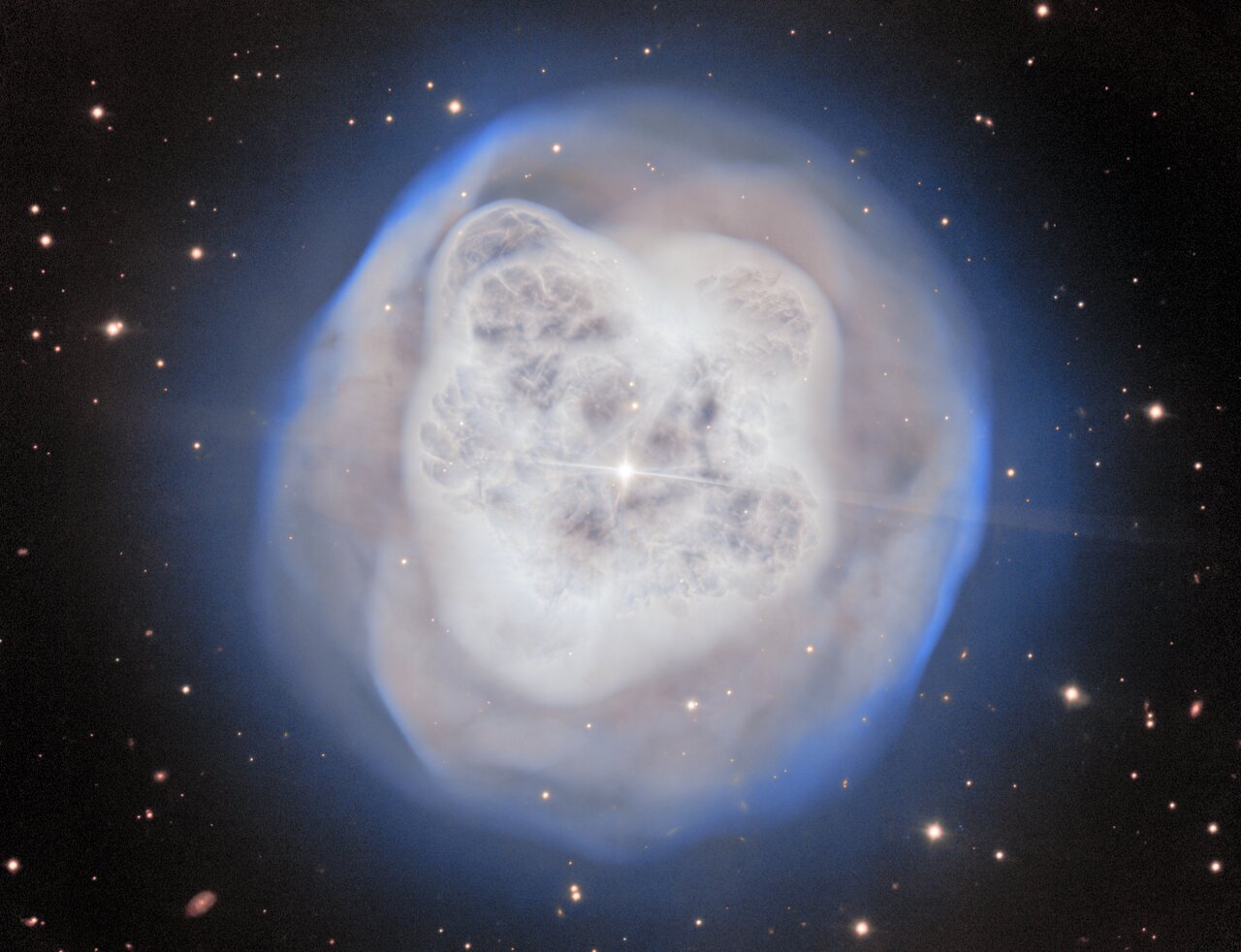
What do you see in this crystal ball? The featured image shows NGC 1514, known as the Crystal Ball Nebula, observed by the Gemini North telescope on Maunakea, in Hawai'i. NGC 1514 is 1,500 light-years away and was discovered by William Herschel in 1790. This planetary nebula is formed when a star becomes a red giant and ejects its outer gas layers. The ejected shell of gas is heated up by the core of the star to temperatures hotter than the surface of our Sun: that makes the gas shine, creating beautiful images like this one. The slightly asymmetrical shape of the Crystal Ball Nebula reveals a secret: the bright star in the center has a companion. As the two stars orbit each other with a period of about nine years, they shape the gas around them. In about 10,000 - 25,000 years the nebula will be dissipated by their stellar winds.