Polaris
Polaris, also known as the North Star, is a multiple-star system located nearly at the North Celestial Pole in the constellation Ursa Minor. Its brightest component, Polaris A, is a classical Cepheid variable supergiant approximately 430 light-years from Earth. The system appears nearly fixed in the sky, making it an important navigational reference.
Source: science.nasa.gov
APODs including "Polaris"
Northern Lights
30/07/2004
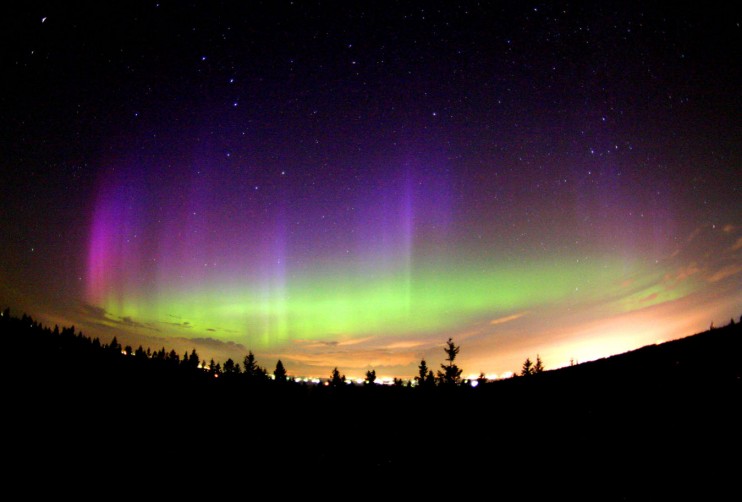
While enjoying the spaceweather on a gorgeous summer evening in mid-July, astronomer Philippe Moussette captured this colorful fish-eye lens view looking north from the Observatoire Mont Cosmos, Quebec, Canada, planet Earth. In the foreground, lights along the northern horizon give an orange cast to the low clouds. But far above the clouds, at altitudes of 100 kilometers or more, are alluring green and purple hues of the aurora borealis or northern lights, a glow powered by energetic particles at the edge of space. In the background are familiar stars of the northern sky. In particular, that famous celestial kitchen utensil, the Big Dipper (left), and the W-shaped constellation Cassiopeia (right) are easy to spot. Then, just follow the pointer stars of the Big Dipper to Polaris, perhaps the most famous northern light of all.