Polaris
Polaris, also known as the North Star, is a multiple-star system located nearly at the North Celestial Pole in the constellation Ursa Minor. Its brightest component, Polaris A, is a classical Cepheid variable supergiant approximately 430 light-years from Earth. The system appears nearly fixed in the sky, making it an important navigational reference.
Source: science.nasa.gov
APODs including "Polaris"
Illuminated Cloud Trails Above Greece
15/03/2010
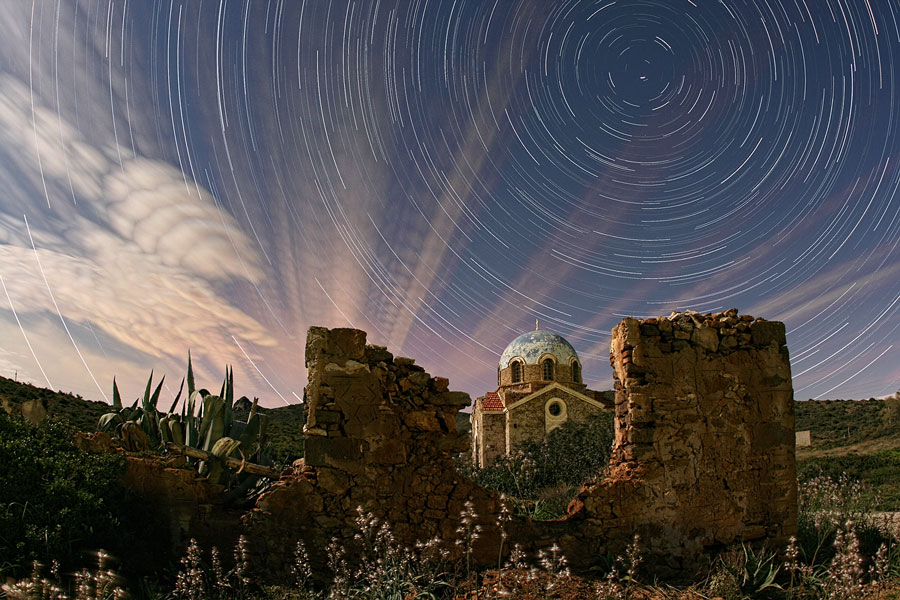
It may appear to be day, but it's night. Those wondrous orange streaks may appear to be rays from the setting Sun, but they're actually thin clouds illuminated by the Moon as they quickly streaked toward the distant horizon. The thick clouds on the far left may appear to have many layers, but actually they are just a few simple clouds captured on numerous separate exposures. What is surely true, though, is that the above time lapse image sequence was taken over two hours, about two weeks ago, in Sounio, Greece. Also, those really are star trails swirling around the north star Polaris on the upper right of the image. But what about the building in the foreground? It may appear to be a famous ancient structure, but it's actually a small deserted church built only last century. Your opinion requested: Is APOD a blog?