Red Giant
A late evolutionary stage of a medium-mass star where the outer layers expand and cool after hydrogen fusion in the core ceases. Red giants can eventually shed their outer envelopes, forming planetary nebulae.
Source: esa.int
APODs including "Red Giant"
Stars Without Galaxies
15/02/1998
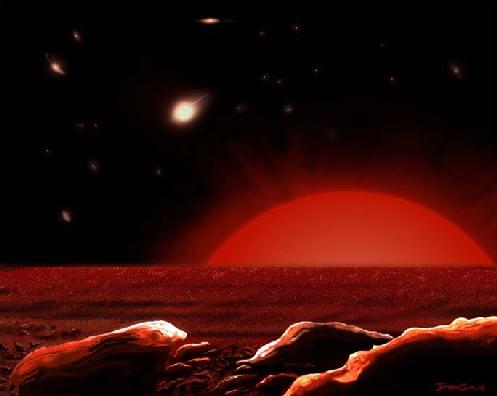
Galaxies are made up of stars, but are all stars found within galaxies? Using the Hubble Space Telescope, researchers exploring the Virgo Cluster of galaxies have now found about 600 red giant stars adrift in intergalactic space. Above is an artist's vision of the sky from a hypothetical planet of such a lonely sun. The night sky on a world orbiting an intergalactic star would be a stark contrast to Earth's - which features a spectacle of stars, all members of our own Milky Way galaxy. As suggested by the illustration, a setting swollen red sun would leave behind a dark sky flecked only with faint, fuzzy, apparitions of Virgo Cluster galaxies. Possibly ejected from their home galaxies during galaxy-galaxy collisions, these isolated suns may well represent part of a large, previously unseen stellar population, filling the space between Virgo Cluster galaxies.