Red Giant
A late evolutionary stage of a medium-mass star where the outer layers expand and cool after hydrogen fusion in the core ceases. Red giants can eventually shed their outer envelopes, forming planetary nebulae.
Source: esa.int
APODs including "Red Giant"
Saturn Rotates
03/10/2000
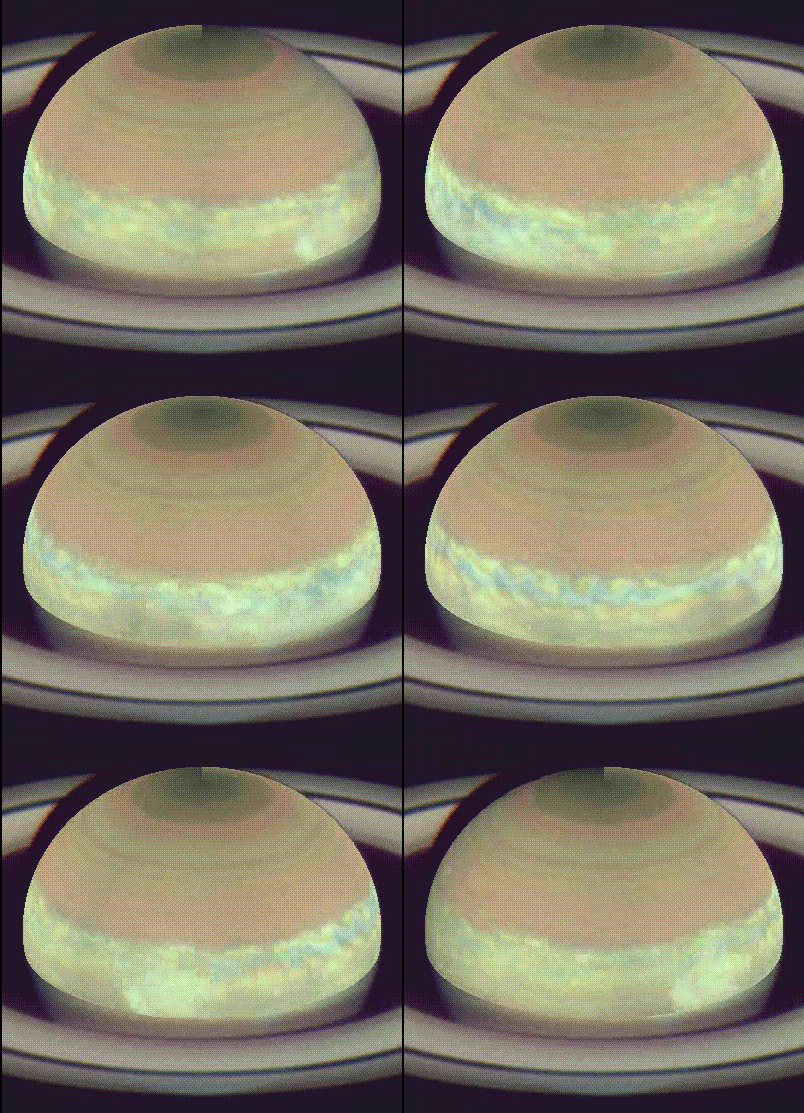
The dramatic rotation of the cloud-tops of Saturn every ten-hours is particularly evident from orbit around the gas giant planet. With a good enough telescope, however, such rotation is visible even from Earth, as shown by this time-lapse image sequence from the Hubble Space Telescope taken in November 1990. Particularly evident at that time was a light-colored giant storm cloud system that completely encircled the planet. The storm was not evident twenty years ago during the flybys of the Voyager spacecraft -- a storm of this magnitude was last noted in 1933. Studying the complex atmosphere of Saturn will be one objective of the Cassini spacecraft launched by NASA in 1997 and expected to arrive in 2004.