Red Giant
A late evolutionary stage of a medium-mass star where the outer layers expand and cool after hydrogen fusion in the core ceases. Red giants can eventually shed their outer envelopes, forming planetary nebulae.
Source: esa.int
APODs including "Red Giant"
Camera Orion
15/10/2008
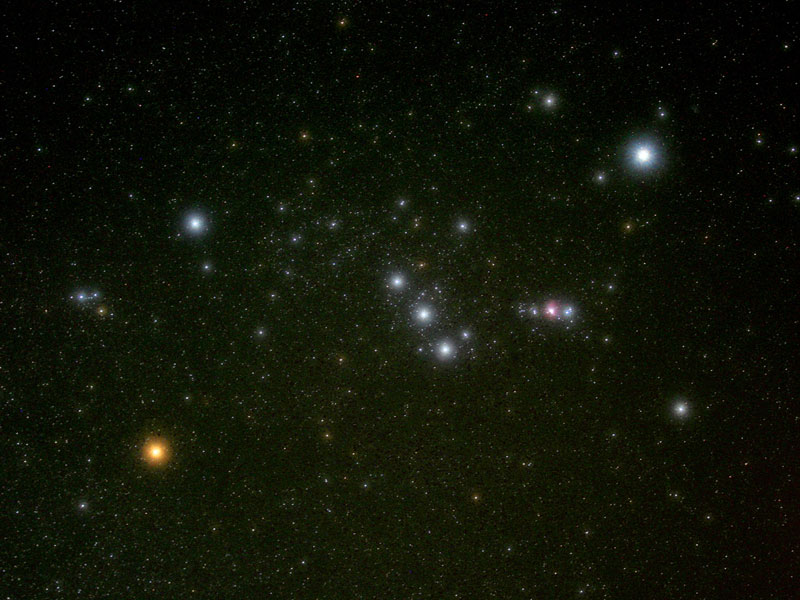
Orion, the Hunter, is one of the most easily recognizable constellations in planet Earth's night sky. But Orion's stars and nebulas don't look quite as colorful to the eye as they do in this lovely camera image, taken early last month at the Black Forest Star Party from Cherry Springs State Park in Pennsylvania, USA. In this single exposure, cool red giant Betelgeuse takes on a yellowish tint as the brightest star at the far left. Otherwise Orion's hot blue stars are numerous, with supergiant Rigel balancing Betelgeuse at the upper right, Bellatrix at the upper left, and Saiph at the lower right. Lined up in Orion's belt (bottom to top) are Alnitak, Alnilam, and Mintaka all about 1,500 light-years away, born of the constellation's well studied interstellar clouds. And if the middle "star" of Orion's sword looks reddish and fuzzy to you, it should. It's the stellar nursery known as the Great Nebula of Orion.