Red Giant
A late evolutionary stage of a medium-mass star where the outer layers expand and cool after hydrogen fusion in the core ceases. Red giants can eventually shed their outer envelopes, forming planetary nebulae.
Source: esa.int
APODs including "Red Giant"
Symbiotic R Aquarii
29/06/2017
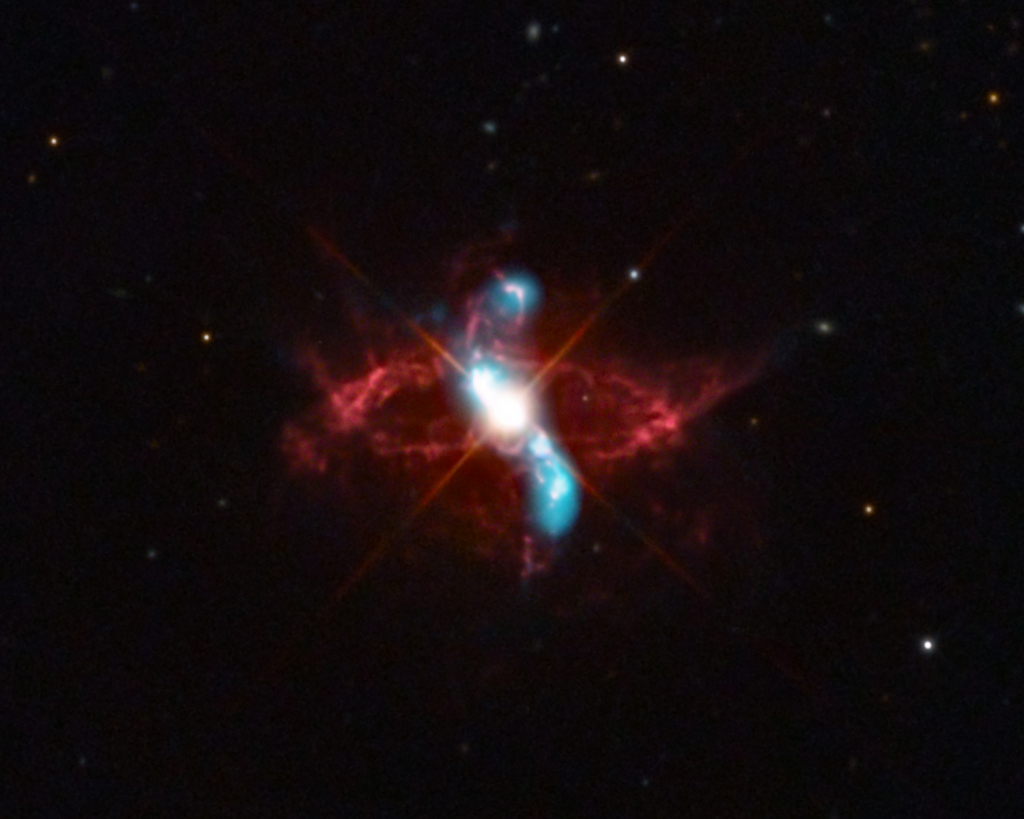
A long recognized naked-eye variable star, R Aquarii is actually an interacting binary star system, two stars that seem to have a close, symbiotic relationship. About 710 light years away, it consists of a cool red giant star and hot, dense white dwarf star in mutual orbit around their common center of mass. The binary system's visible light is dominated by the red giant, itself a Mira-type long period variable star. But material in the cool giant star's extended envelope is pulled by gravity onto the surface of the smaller, denser white dwarf, eventually triggering a thermonuclear explosion and blasting material into space. Optical image data (red) shows the still expanding ring of debris originating from a blast that would have been seen in the early 1770s. The evolution of less understood energetic events producing high energy emission in the R Aquarii system has been monitored since 2000 using Chandra X-ray Observatory data (blue). The composite field of view is less that a light-year across at the estimated distance of R Aquarii.