Redshift
In astronomy, redshift refers to the phenomenon where light or other electromagnetic radiation from an object is shifted toward longer (redder) wavelengths. This effect results in a decrease in frequency and energy and occurs in three primary contexts: Doppler redshift, gravitational redshift, and cosmological redshift.
Doppler redshift happens when a light-emitting object moves away from the observer. Similar to how a siren sounds lower in pitch as it moves away, the light’s wavelength is stretched. Gravitational redshift, predicted by Einstein’s General Theory of Relativity, occurs when light escapes a strong gravitational field and loses energy, resulting in longer wavelengths. Cosmological redshift is due to the expansion of the universe itself: as space expands, it stretches the light traveling through it, increasing the wavelength.
Redshift is measured using the dimensionless parameter z, calculated as z = (λ_observed − λ_emitted) / λ_emitted. For relatively nearby galaxies, this can be directly related to velocity via v ≈ z × c, where c is the speed of light. In very distant galaxies, redshift indicates how long the light has been traveling and, by extension, how far away the galaxy is.
Redshift is central to modern cosmology. Edwin Hubble’s discovery in 1929 that more distant galaxies exhibit greater redshifts led to the formulation of Hubble’s Law, which describes the expanding universe. Measuring the redshifts of galaxies and supernovae has also revealed that the universe’s expansion is accelerating, suggesting the presence of dark energy.
Astronomers detect redshift by comparing the known spectral lines of elements (like hydrogen or calcium) to those observed in light from distant sources. The greater the shift, the farther and older the object is. Today, some galaxies have been observed with redshifts greater than 13, meaning their light has traveled for over 13 billion years, offering a glimpse into the early universe.
Sources
APODs including "Redshift"
The GRB 110328A Symphony
19 April 2011
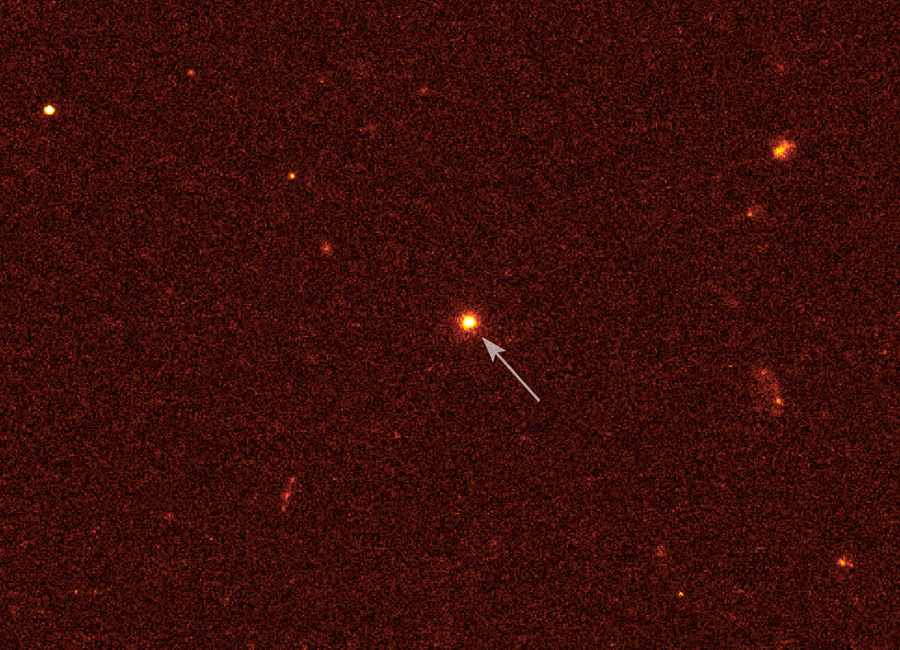
A symphony of planet-wide observations began abruptly on March 28 when the Earth-orbiting Swift satellite detected a burst of high-frequency gamma-rays from GRB 110328A. When the same source flared again after a 45 minute pause it was clear this event was not a typical gamma-ray burst. Twelve hours after the initial fanfare astronomers using the 2.5-meter Nordic Optical Telescope chimed in with a mid-range observation of the optical counterpart. Early the next day the explosion was picked up in baritone low-frequencies of radio waves by the EVLA radio dishes in the USA. Later many optical telescopes, including the 8-meter Gemini North telescope in Hawaii, began playing along by tracking the optical counterpart. The unusual source was spotted at a higher register in X-rays by the Chandra X-ray Observatory and was intermittently followed in the even more soprano-like gamma-ray range for a week. Joining the chorus, Hubble Space Telescope recorded this image in optical and infrared light, confirming that the flash was located along the path of a galaxy at redshift 0.351. If associated with the galaxy, this explosion occurred when the universe was about two thirds of its present age. There is much speculation that the unusual gamma-ray burst was a star being ripped apart by a supermassive black hole in the center of a galaxy and the puzzling features of the distant detonation are still being explored.