Reflection Nebula
A reflection nebula is a cloud of interstellar dust that becomes visible due to the light from nearby stars reflecting off its particles. Unlike emission nebulae, reflection nebulae do not emit their own light but shine by scattering the light of nearby stars.
Source: science.nasa.gov
APODs including "Reflection Nebula"
Elusive Jellyfish Nebula
08/04/2004
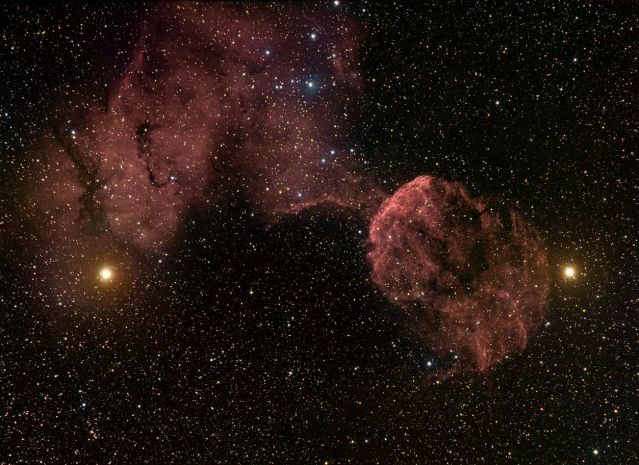
Normally faint and elusive, the Jellyfish Nebula is caught in the net of this spectacular wide-field telescopic view. Flanked by two yellow-tinted stars at the foot of a celestial twin - Mu and Eta Geminorum - the Jellyfish Nebula is the brighter arcing ridge of emission with dangling tentacles just right of center. Here, the cosmic jellyfish is seen to be part of bubble-shaped supernova remnant IC 443, the expanding debris cloud from an exploded star some 5,000 light-years away. Also in view, emission nebula IC 444 nearly fills the field to the upper left, dotted with small blue reflection nebulae. Like its cousin in astrophysical waters, the Crab Nebula, IC 443 is known to harbor a neutron star, the collapsed core of the massive star that exploded over 30,000 years ago.