Reflection Nebula
A reflection nebula is a cloud of interstellar dust that becomes visible due to the light from nearby stars reflecting off its particles. Unlike emission nebulae, reflection nebulae do not emit their own light but shine by scattering the light of nearby stars.
Source: science.nasa.gov
APODs including "Reflection Nebula"
Antares and Rho Ophiuchi
09/05/2004
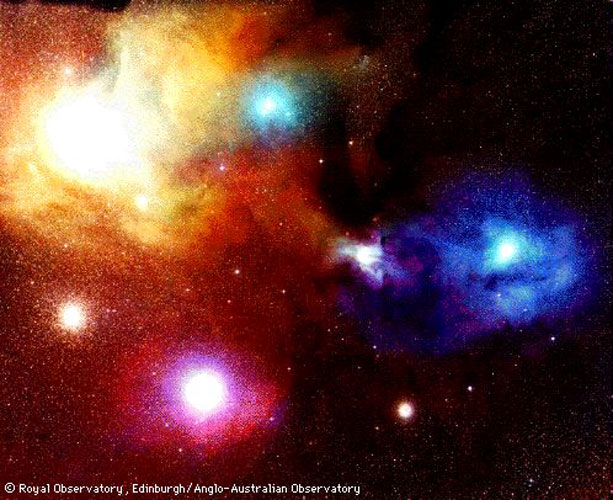
Why is the sky near Antares and Rho Ophiuchi so colorful? The colors result from a mixture of objects and processes. Fine dust illuminated from the front by starlight produces blue reflection nebulae. Gaseous clouds whose atoms are excited by ultraviolet starlight produce reddish emission nebulae. Backlit dust clouds block starlight and so appear dark. Antares, a red supergiant and one of the brighter stars in the night sky, lights up the yellow-red clouds on the upper left. Rho Ophiuchi lies at the center of the blue nebula on the right. The distant globular cluster M4 is visible just below Antares, and to the left of the red cloud engulfing Sigma Scorpii. These star clouds are even more colorful than humans can see, emitting light across the electromagnetic spectrum.