Reflection Nebula
A reflection nebula is a cloud of interstellar dust that becomes visible due to the light from nearby stars reflecting off its particles. Unlike emission nebulae, reflection nebulae do not emit their own light but shine by scattering the light of nearby stars.
Source: science.nasa.gov
APODs including "Reflection Nebula"
Stardust in Perseus
29/11/2007
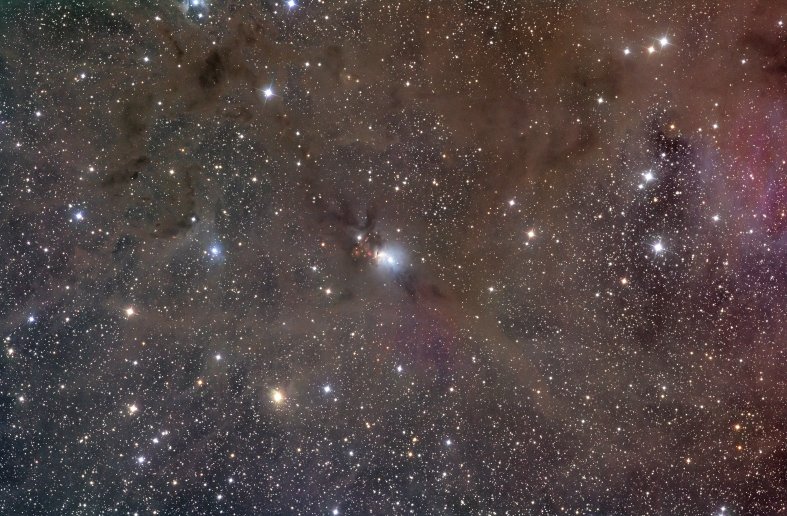
This cosmic expanse of dust, gas, and stars covers some 4 degrees on the sky in the heroic constellation Perseus. Centered in the gorgeous skyscape is the dusty blue reflection nebula NGC 1333, about 1,000 light-years away. At that estimated distance, the field of view is nearly 70 light-years across. Other reflection nebulae are scattered around, along with remarkable dark dust nebulae and the faint reddish glow of hydrogen gas. These dust and gas clouds lie near the edge of a large molecular cloud. Themselves telltale signs of star-forming regions, they tend to hide the newly formed stars and young stellar objects or protostars from prying optical telescopes. Collapsing due to self-gravity, the protostars form around dense cores embedded in the molecular cloud.