Reflection Nebula
A reflection nebula is a cloud of interstellar dust that becomes visible due to the light from nearby stars reflecting off its particles. Unlike emission nebulae, reflection nebulae do not emit their own light but shine by scattering the light of nearby stars.
Source: science.nasa.gov
APODs including "Reflection Nebula"
Amazing Comet Holmes
24/10/2008
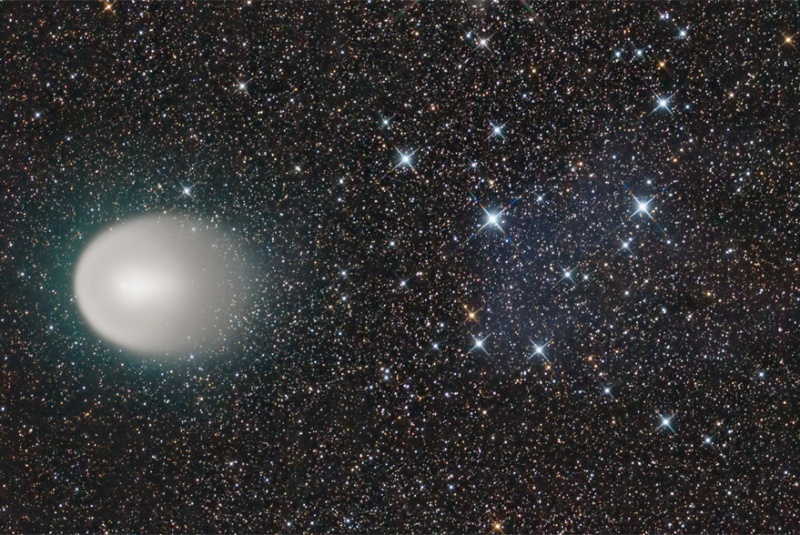
One year ago, Comet 17P/Holmes amazed sky watchers across planet Earth. A stunningly rapid outburst transformed it from a faint comet quietly orbiting the Sun with a period of about 7 years to a naked-eye comet rivaling the brighter stars in the constellation Perseus. Its largely tail-less shape, as in this wide-angle view recorded on November 11, 2007, became well-known to astronomers trying to unravel the mystery of the comet's surprising outburst . Still, Comet Holmes had a dim ion tail that was seen to separate from the bright coma. In this image, the separated tail creates the illusion of a reflection nebula. It appears as a faint bluish haze right of center against a background of stars in the loosely grouped Alpha Persei Moving Cluster.