Reflection Nebula
A reflection nebula is a cloud of interstellar dust that becomes visible due to the light from nearby stars reflecting off its particles. Unlike emission nebulae, reflection nebulae do not emit their own light but shine by scattering the light of nearby stars.
Source: science.nasa.gov
APODs including "Reflection Nebula"
Stars in a Dusty Sky
28/09/2012
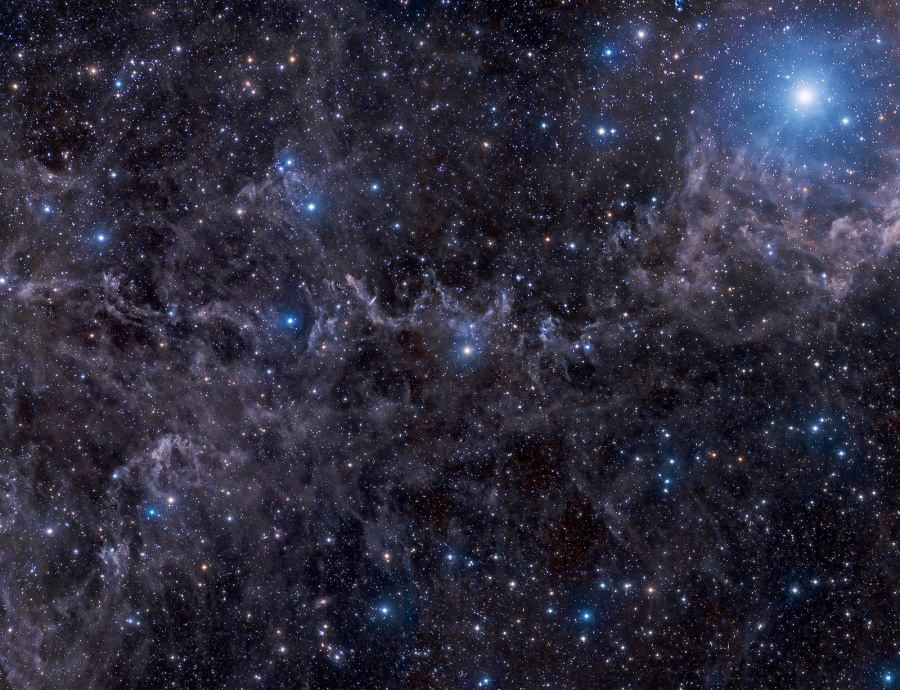
Bright star Markab anchors this dusty skyscape. At the top right corner of the frame, Markab itself marks a corner of an asterism known as the Great Square, found within the boundaries of the constellation Pegasus, the flying horse. The wide and deep telescopic view rides along for some 5 degrees or about 10 times the angular diameter of the Full Moon, with blue reflection nebulae scattered around the scene. And even though this line-of-sight looks away from the plane of our Milky Way galaxy, it covers a region known to be filled with nearby molecular clouds. The associated dust clouds, high latitude galactic cirrus, are less than 1,000 light-years distant. Still apparent, but far beyond the Milky Way, are background galaxies, like the prominent edge-on spiral NGC 7497 near picture center.