Reflection Nebula
A reflection nebula is a cloud of interstellar dust that becomes visible due to the light from nearby stars reflecting off its particles. Unlike emission nebulae, reflection nebulae do not emit their own light but shine by scattering the light of nearby stars.
Source: science.nasa.gov
APODs including "Reflection Nebula"
Reflections on vdB 9
21/02/2019
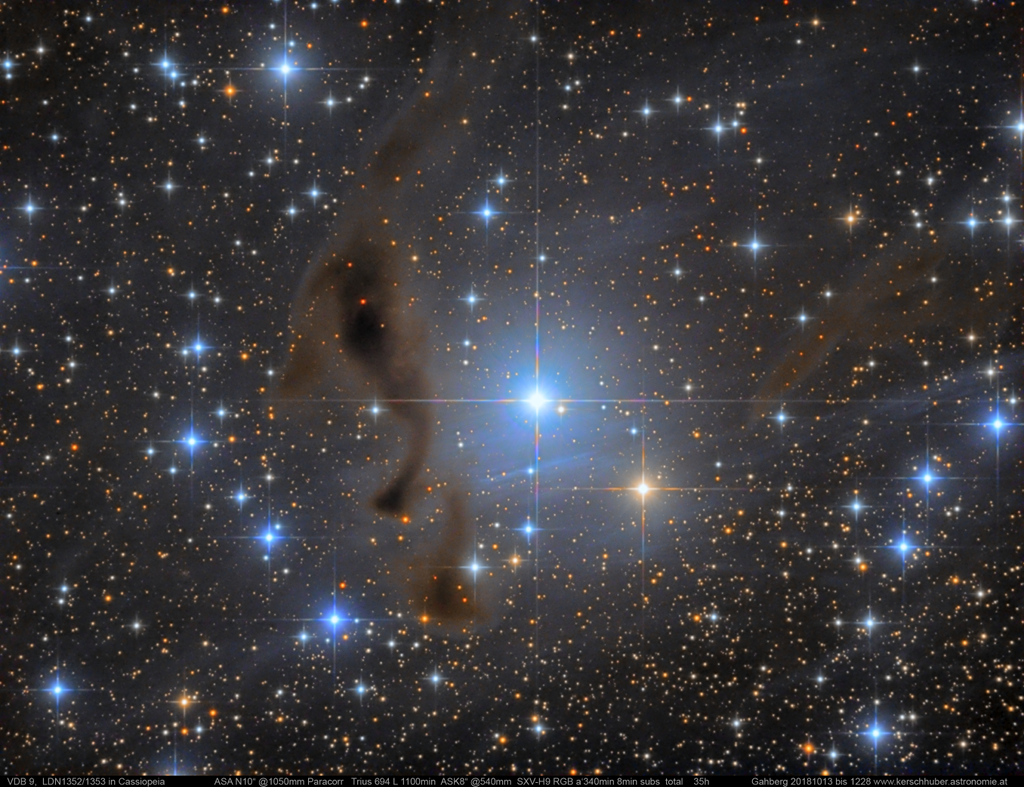
Centered in a well-composed celestial still life, pretty, blue vdB 9 is the 9th object in Sidney van den Bergh's 1966 catalog of reflection nebulae. It shares this telescopic field of view, about twice the size of a full moon on the sky, with stars and dark, obscuring dust clouds in the northerly constellation Cassiopeia. Cosmic dust is preferentially reflecting blue starlight from embedded, hot star SU Cassiopeiae, giving vdB 9 the characteristic bluish tint associated with a classical reflection nebula. SU Cas is a Cepheid variable star, though even at its brightest it is just too faint to be seen with the unaided eye. Still Cepheids play an important role in determining distances in our galaxy and beyond. At the star's well-known distance of 1,540 light-years, this cosmic canvas would be about 24 light-years across.