Rosette Nebula
The Rosette Nebula (NGC 2237–39, 2244) is a large H II region and stellar nursery about 5,200 light‑years away in the constellation Monoceros. Spanning roughly 100 light‑years, it consists of a central cavity surrounded by ionized gas illuminated and sculpted by the young star cluster NGC 2244, with pillars, cavities, and ongoing star formation.
Source: science.nasa.gov
APODs including "Rosette Nebula"
The Rosette Nebula in Hydrogen, Oxygen, and Sulfur
11/01/2000
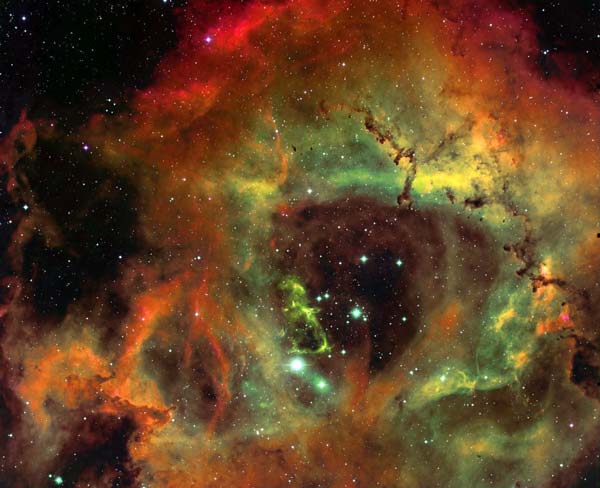
The Rosette Nebula is a large emission nebula located 3000 light-years away. The great abundance of hydrogen gas gives NGC 2237 its red color in most photographs. The wind from the open cluster of stars known as NGC 2244 has cleared a hole in the nebula's center. The above photograph, however, was taken in the light emitted by three elements of the gas ionized by the energetic central stars. Here green light originating from oxygen and blue light originating from sulfur supplements the red from hydrogen. Filaments of dark dust lace run through the nebula's gases. The origin of recently observed fast-moving molecular knots in the Rosette Nebula remains under investigation.