Rosette Nebula
The Rosette Nebula (NGC 2237–39, 2244) is a large H II region and stellar nursery about 5,200 light‑years away in the constellation Monoceros. Spanning roughly 100 light‑years, it consists of a central cavity surrounded by ionized gas illuminated and sculpted by the young star cluster NGC 2244, with pillars, cavities, and ongoing star formation.
Source: science.nasa.gov
APODs including "Rosette Nebula"
Camera Orion Rising
31/01/2024
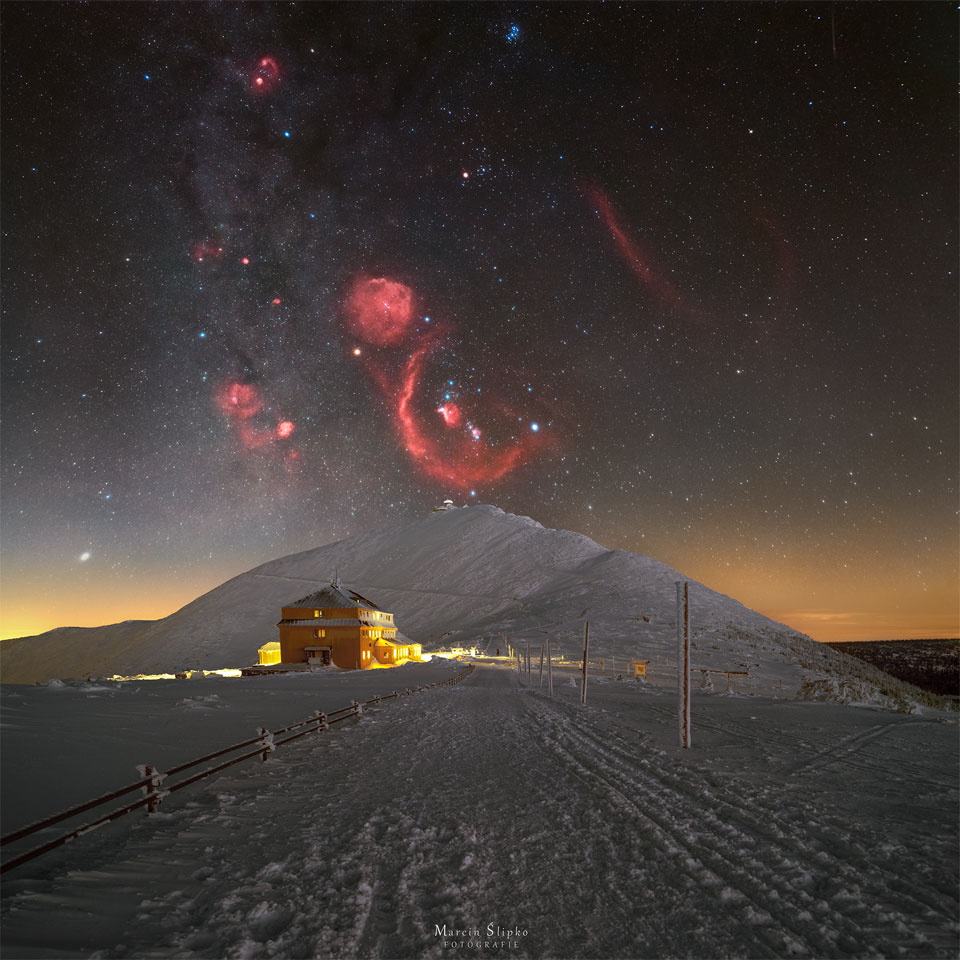
What does Orion rising look like to a camera? During this time of the year, the famous constellation is visible to the southeast just after sunset. From most Earthly locations, Orion's familiar star pattern, highlighted by the three-stars-in-a-row belt stars, rises sideways. An entire section of the night sky that includes Orion was photographed rising above Śnieżka, a mountain on the border between Poland and the Czech Republic. The long duration exposure sequence brings up many faint features including the Orion and Flame Nebulas, both encompassed by the curving Barnard's Loop. The featured wide-angle camera composite also captured night sky icons including the blue Pleiades star cluster at the image top and the red Rosette Nebula to the left of Orion. Famous stars in the frame include Procyon, Betelgeuse, Rigel and Aldebaran. Orion will appear successively higher in the sky at sunset during the coming months.