Satellite galaxy
A satellite galaxy is a smaller galaxy, typically a dwarf, that is gravitationally bound and orbits a larger host galaxy. These companion galaxies may eventually be tidally disrupted or merge with their hosts, and often contain between a few thousand and a few billion stars.
Source: esa.int
APODs including "Satellite galaxy"
M33: The Triangulum Galaxy
8 July 1996
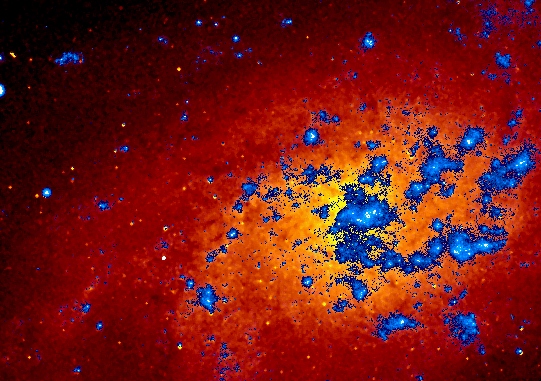
The spiral galaxy M33 is a mid-sized member of our Local Group of galaxies. M33 is also called the Triangulum Galaxy for the constellation in which it resides. About four times smaller (in radius) than our Milky Way Galaxy and the Andromeda Galaxy (M31), it is much larger than the many of the local dwarf spheroidal galaxies. M33's proximity to M31 causes it to be thought by some to be a satellite galaxy of this more massive galaxy. M33's proximity to our Milky Way galaxy causes it to appear more than twice the angular size of the full moon, and visible with a good pair of binoculars. In the above picture, visible light is shown in red and ultraviolet light superposed in blue. Stars in M33 are the most distant ever to be studied spectroscopically.