Satellite galaxy
A satellite galaxy is a smaller galaxy, typically a dwarf, that is gravitationally bound and orbits a larger host galaxy. These companion galaxies may eventually be tidally disrupted or merge with their hosts, and often contain between a few thousand and a few billion stars.
Source: esa.int
APODs including "Satellite galaxy"
NGC 602 and Beyond
2 April 2017
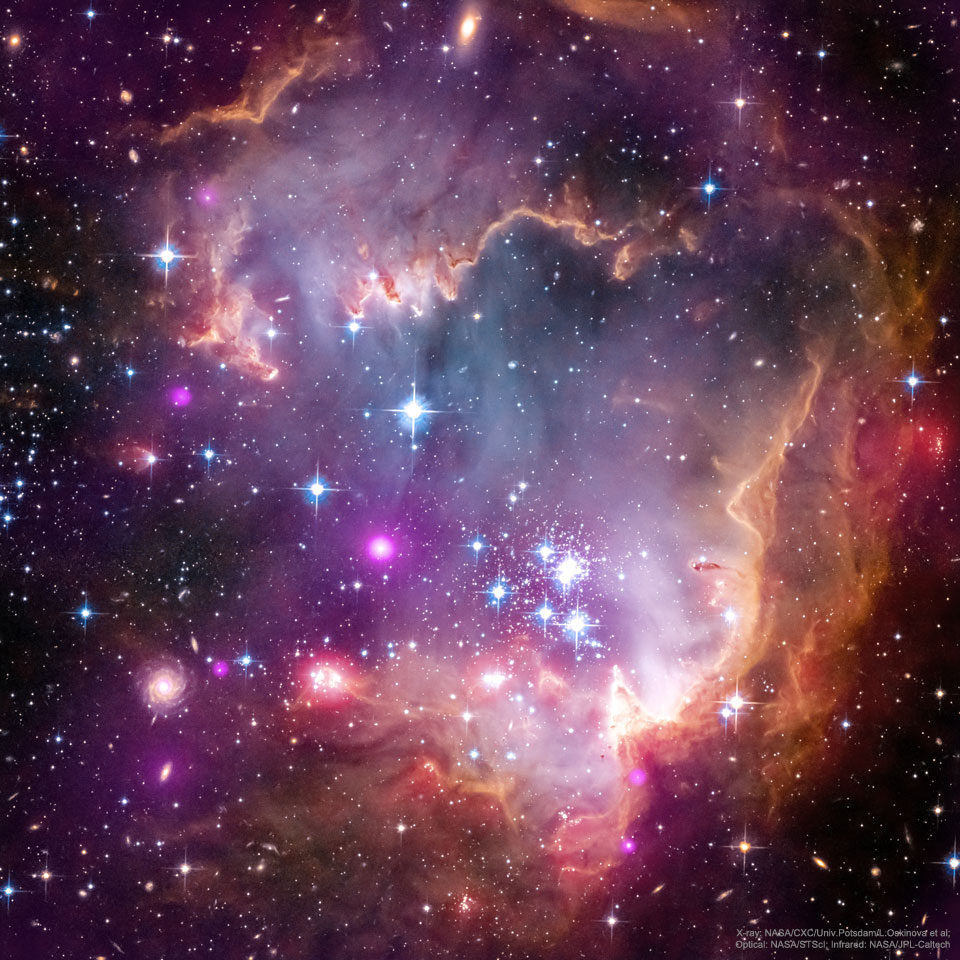
Near the outskirts of the Small Magellanic Cloud, a satellite galaxy some 200 thousand light-years distant, lies 5 million year young star cluster NGC 602. Surrounded by natal gas and dust, NGC 602 is featured in this stunning Hubble image of the region, augmented by images in the X-ray by Chandra, and in the infrared by Spitzer. Fantastic ridges and swept back shapes strongly suggest that energetic radiation and shock waves from NGC 602's massive young stars have eroded the dusty material and triggered a progression of star formation moving away from the cluster's center. At the estimated distance of the Small Magellanic Cloud, the Picture spans about 200 light-years, but a tantalizing assortment of background galaxies are also visible in this sharp multi-colored view. The background galaxies are hundreds of millions of light-years or more beyond NGC 602. Open Science: Browse 1,400+ codes in the Astrophysics Source Code Library