Satellite galaxy
A satellite galaxy is a smaller galaxy, typically a dwarf, that is gravitationally bound and orbits a larger host galaxy. These companion galaxies may eventually be tidally disrupted or merge with their hosts, and often contain between a few thousand and a few billion stars.
Source: esa.int
APODs including "Satellite galaxy"
M83: Star Streams and a Thousand Rubies
3 July 2024
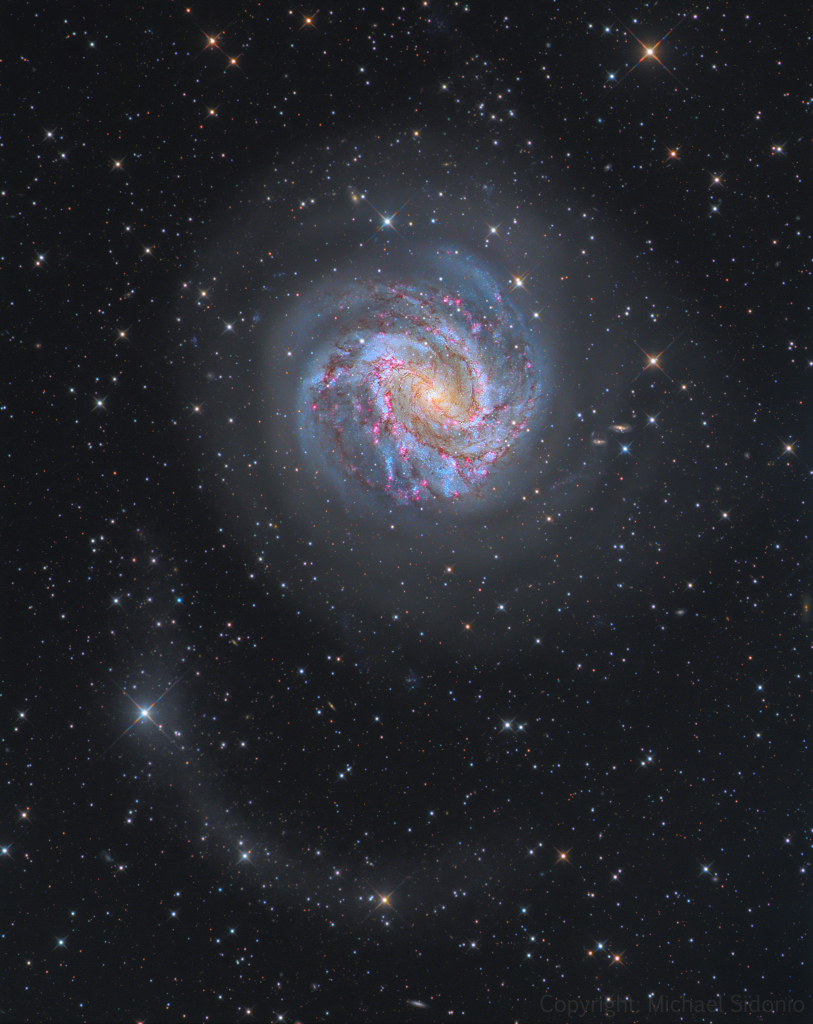
Big, bright, and beautiful, spiral galaxy M83 lies a mere twelve million light-years away, near the southeastern tip of the very long constellation Hydra. About 40,000 light-years across, M83 is known as the Southern Pinwheel for its pronounced spiral arms. But the wealth of reddish star forming regions found near the edges of the arms' thick dust lanes, also suggest another popular moniker for M83, the Thousand-Ruby Galaxy. This new deep telescopic digital image also records the bright galaxy's faint, extended halo. Arcing toward the bottom of the cosmic frame lies a stellar tidal stream, debris drawn from massive M83 by the gravitational disruption of a smaller, merging satellite galaxy. Astronomers David Malin and Brian Hadley found the elusive star stream in the mid 1990s by enhancing photographic plates.