Saturn
The sixth planet from the Sun, known for its stunning ring system composed of ice particles, rock debris, and dust. Saturn is the second-largest planet in the Solar System and is visible to the naked eye under dark skies.
Source: solarsystem.nasa.gov
APODs including "Saturn"
A Glimpse of Titan's Surface
21/10/1995
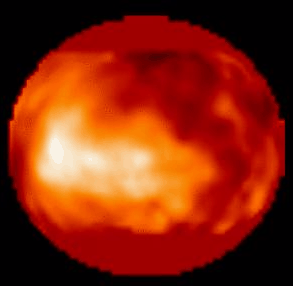
The surface of Titan, Saturn's largest moon, is normally hidden from view by its thick, hazy atmosphere. However, for the first time astronomers have been able to see surface features in images like the one above, made at near-infrared wavelengths with the Hubble Space Telescope. At these wavelengths (longer than visible light) Titan's smog like atmosphere begins to be transparent enough to allow glimpses of it's surface. The bright feature seen above is about 2,500 miles across, similar in size to Australia. Astronomers are still trying to work out what the bright and dark areas represent - oceans, continents, craters, or other features. The images represent important information for planning the Cassini mission, scheduled for launch in 1997. The Cassini spacecraft will explore the Saturn system and parachute a probe to Titan's surface.