Saturn
The sixth planet from the Sun, known for its stunning ring system composed of ice particles, rock debris, and dust. Saturn is the second-largest planet in the Solar System and is visible to the naked eye under dark skies.
Source: solarsystem.nasa.gov
APODs including "Saturn"
A Sky Full Of Planets
04/12/1997
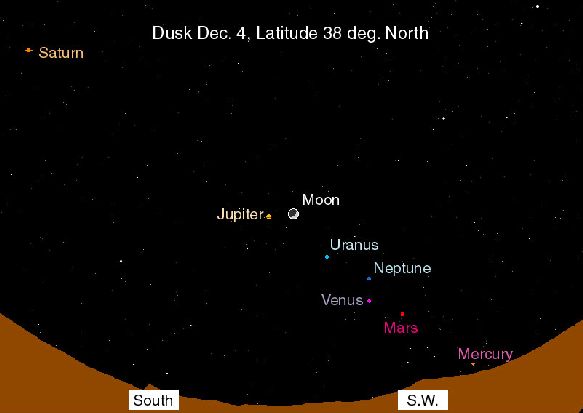
Look up tonight. Just after sunset, the crescent moon and all five "naked-eye" planets (Mercury, Venus, Mars, Jupiter, and Saturn) will be visible (depending on your latitude), lying near our solar system's ecliptic plane. Venus and Jupiter will shine brilliantly as the brightest "stars" in the sky, but Mercury will be near the horizon and hard to see. A pair of binoculars will also reveal Uranus and Neptune and observers with a telescope and a good site may even be able to glimpse faint Pluto just above the Western horizon in the fading twilight (not shown on the chart above). Enjoy this lovely spectacle any clear night through about December 8. A similar gathering is expected in May 2000 but the planets will be hidden from view by the solar glare. A night sky as full of planets as this one will occur again though ... in about 100 years.