Saturn
The sixth planet from the Sun, known for its stunning ring system composed of ice particles, rock debris, and dust. Saturn is the second-largest planet in the Solar System and is visible to the naked eye under dark skies.
Source: solarsystem.nasa.gov
APODs including "Saturn"
The Ecliptic Plane
14/10/2000
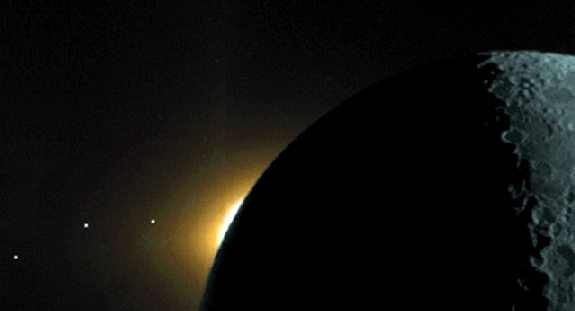
The Plane of the Ecliptic is well illustrated in this picture from the 1994 lunar prospecting Clementine spacecraft. Clementine's star tracker camera image reveals (from right to left) the Moon lit by Earthshine, the Sun's corona rising over the Moon's dark limb, and the planets Saturn, Mars, and Mercury. The ecliptic plane is defined as the imaginary plane containing the Earth's orbit around the Sun. In the course of a year, the Sun's apparent path through the sky lies in this plane. The Solar System's planetary bodies all tend to lie near this plane, since they were formed from the Sun's spinning, flattened, proto-planetary disk. The snapshot above nicely captures a momentary line-up looking out along this fundamental plane of our Solar System.