Saturn
The sixth planet from the Sun, known for its stunning ring system composed of ice particles, rock debris, and dust. Saturn is the second-largest planet in the Solar System and is visible to the naked eye under dark skies.
Source: solarsystem.nasa.gov
APODs including "Saturn"
Southern Saturn from Cassini
18/10/2004
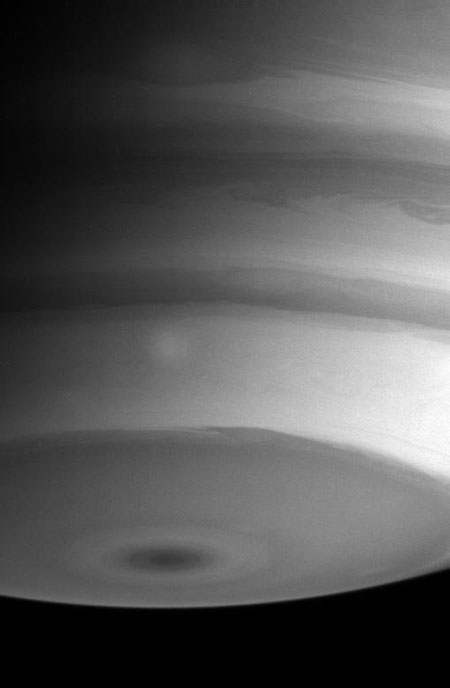
What happens to Saturn's pervasive clouds at its South Pole? Visible in the above image of Saturn are bright bands, dark belts and a dark spot right over the South Pole. The above image in infrared light spans over 30,000 kilometers and was taken early last month by the robot Cassini spacecraft currently orbiting Saturn. Saturn's atmosphere is about 75 percent hydrogen, 25 percent helium, and small amounts of heavier compounds including water vapor, methane, and ammonia. The relatively low gravity at Saturn's cloud tops result in a thicker haze layer, which in turn makes atmospheric features blurrier than Jupiter.