Saturn
The sixth planet from the Sun, known for its stunning ring system composed of ice particles, rock debris, and dust. Saturn is the second-largest planet in the Solar System and is visible to the naked eye under dark skies.
Source: solarsystem.nasa.gov
APODs including "Saturn"
Three Planets from Mt. Hamilton
30/06/2005
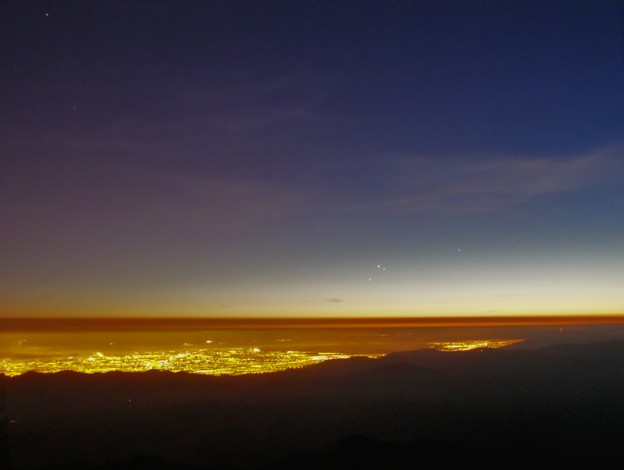
Venus, Mercury, and Saturn wandered close together in western evening skies last week. On Saturnday, June 25, astronomer R. Jay GaBany recorded this snapshot of their eye-catching planetary conjunction, from historic Lick Observatory on Mt. Hamilton, California, USA. The view looks toward the Pacific shortly after sunset with the lights of San Jose and the southern San Francisco Bay area in the foreground. Of course, Venus is the brightest of the trio. Mercury is nearby on the right and Saturn is below and left, closest to the horizon. Farther to the right of the planetary triangle are Pollux and Castor, twin stars of Gemini, with Regulus, bright star of the constellation Leo, at the very upper left corner of the picture. In the coming days, Venus and Mercury remain close, while Saturn continues to drop below them, toward the horizon.