Saturn
The sixth planet from the Sun, known for its stunning ring system composed of ice particles, rock debris, and dust. Saturn is the second-largest planet in the Solar System and is visible to the naked eye under dark skies.
Source: solarsystem.nasa.gov
APODs including "Saturn"
Iapetus: 3D Equatorial Ridge
15/09/2007
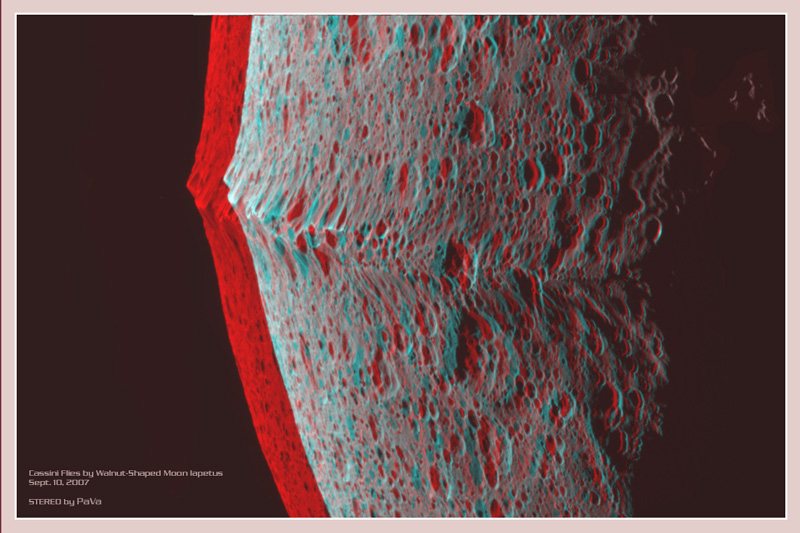
This bizarre, equatorial ridge extending across and beyond the dark, leading hemisphere of Iapetus gives the two-toned Saturnian moon a distinct walnut shape. With red/blue glasses you can check out a remarkable stereo composition of this extraordinary feature -- based on close-up images from this week's Cassini spacecraft flyby. In fact, the ridge's combination of equatorial symmetry and scale, about 20 kilometers wide and reaching up to 20 kilometers above the surface, is not known to be duplicated anywhere else in our solar system. The unique feature was discovered in Cassini images from 2004. It appears to be heavily cratered and therefore ancient, but the origin of the equatorial ridge on Iapetus remains a mystery.