Saturn
The sixth planet from the Sun, known for its stunning ring system composed of ice particles, rock debris, and dust. Saturn is the second-largest planet in the Solar System and is visible to the naked eye under dark skies.
Source: solarsystem.nasa.gov
APODs including "Saturn"
The Strange Trailing Side of Saturn's Iapetus
10/10/2007
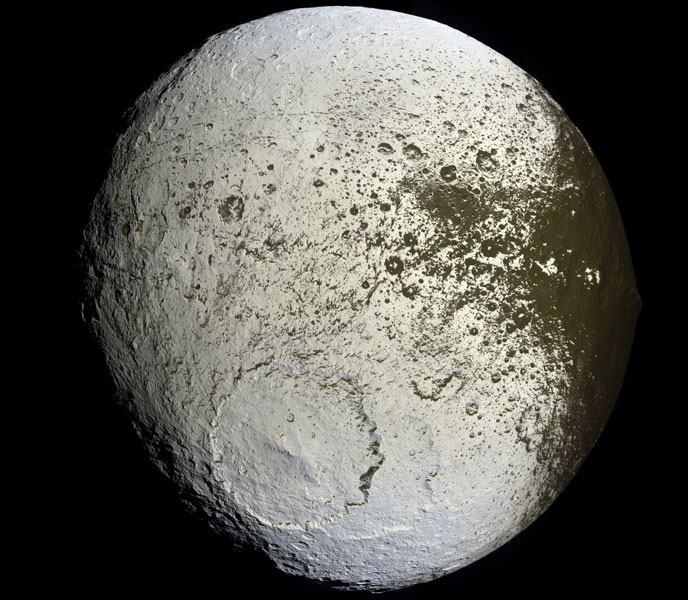
What has happened to Saturn's moon Iapetus? Vast sections of this strange world are dark as coal, while others are as bright as ice. The composition of the dark material is unknown, but infrared spectra indicate that it possibly contains some dark form of carbon. Iapetus also has an unusual equatorial ridge that makes it appear like a walnut. To help better understand this mysterious moon, NASA directed the robotic Cassini spacecraft orbiting Saturn to swoop within 2,000 kilometers just last month. Pictured above, from about 75,000 kilometers out, Cassini's trajectory allowed unprecedented imaging of the hemisphere of Iapetus that is always trailing. A huge impact crater seen in the south spans a tremendous 450 kilometers and appears superposed on an older crater of similar size. The dark material is seen increasingly coating the easternmost part of Iapetus, darkening craters and highlands alike. Close inspection indicates that the dark coating typically faces the moon's equator. Whether Iapetus' colors are the result of unusual episodes of internal volcanism or external splattering remains unknown. This and other images from Cassini's Iapetus flyby are being studied for even greater clues.