Saturn
The sixth planet from the Sun, known for its stunning ring system composed of ice particles, rock debris, and dust. Saturn is the second-largest planet in the Solar System and is visible to the naked eye under dark skies.
Source: solarsystem.nasa.gov
APODs including "Saturn"
Saturn's Moon Epimetheus from the Cassini Spacecraft
11/02/2008
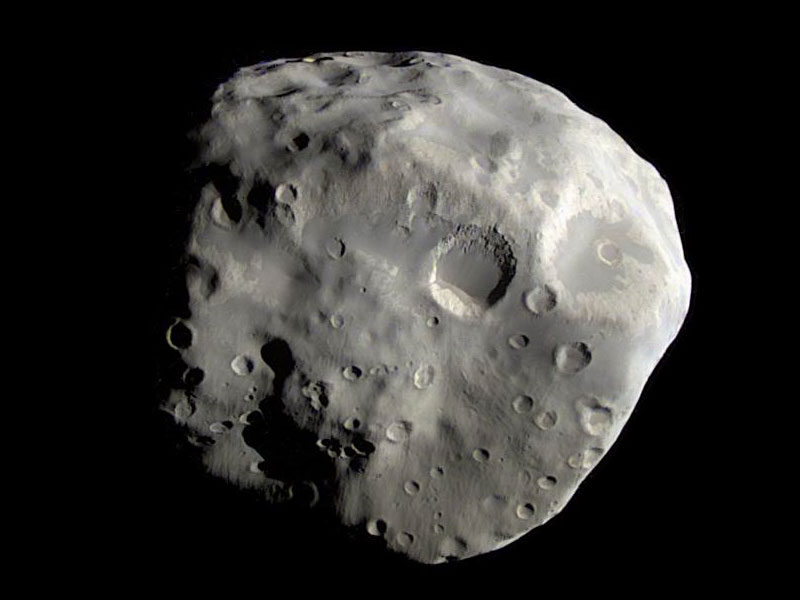
How did Epimetheus form? No one is yet sure. To help answer that question, this small moon has recently been imaged again in great detail by the robot spacecraft Cassini now orbiting Saturn. Epimetheus sometimes orbits Saturn in front of Janus, another small satellite, but sometimes behind. The above image, taken last December, shows a surface covered with craters indicating great age. Epimetheus spans about 115 kilometers across. Epimetheus does not have enough surface gravity to restructure itself into a sphere. The flattened face of Epimetheus shown above might have been created by a single large impact.