Saturn
The sixth planet from the Sun, known for its stunning ring system composed of ice particles, rock debris, and dust. Saturn is the second-largest planet in the Solar System and is visible to the naked eye under dark skies.
Source: solarsystem.nasa.gov
APODs including "Saturn"
6 Years of Saturn
04/09/2009
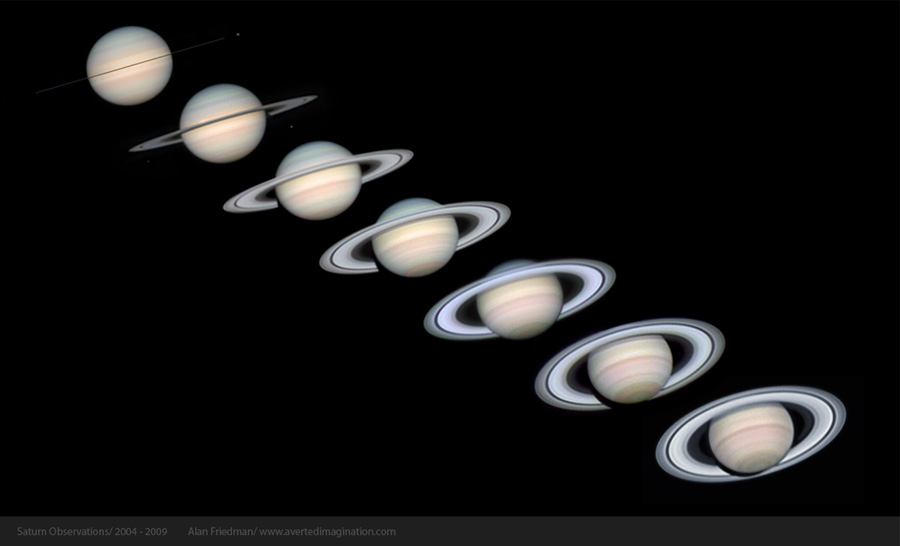
Today, planet Earth passes through the plane of Saturn's rings. From the perspective of earthbound astronomers, Saturn's rings will be edge-on. The problem is, Saturn itself is now very close to the Sun, low on horizon after sunset, so good telescopic images will be difficult to come by. Still, this composite of Saturn views taken from 2004 - 2009 (lower right to upper left) illustrates the change in ring tilt over the last six years and includes a nearly edge-on ring view, based on images captured earlier this year. While Saturn's south pole is clearly seen in the sequence, particularly at the lower right, it will be hidden in the coming years. Saturn's north pole will be increasingly visible, along with the tilting rings, as the planet emerges this fall in the predawn sky.