Saturn
The sixth planet from the Sun, known for its stunning ring system composed of ice particles, rock debris, and dust. Saturn is the second-largest planet in the Solar System and is visible to the naked eye under dark skies.
Source: solarsystem.nasa.gov
APODs including "Saturn"
The Kepler-90 Planetary System
18/12/2017
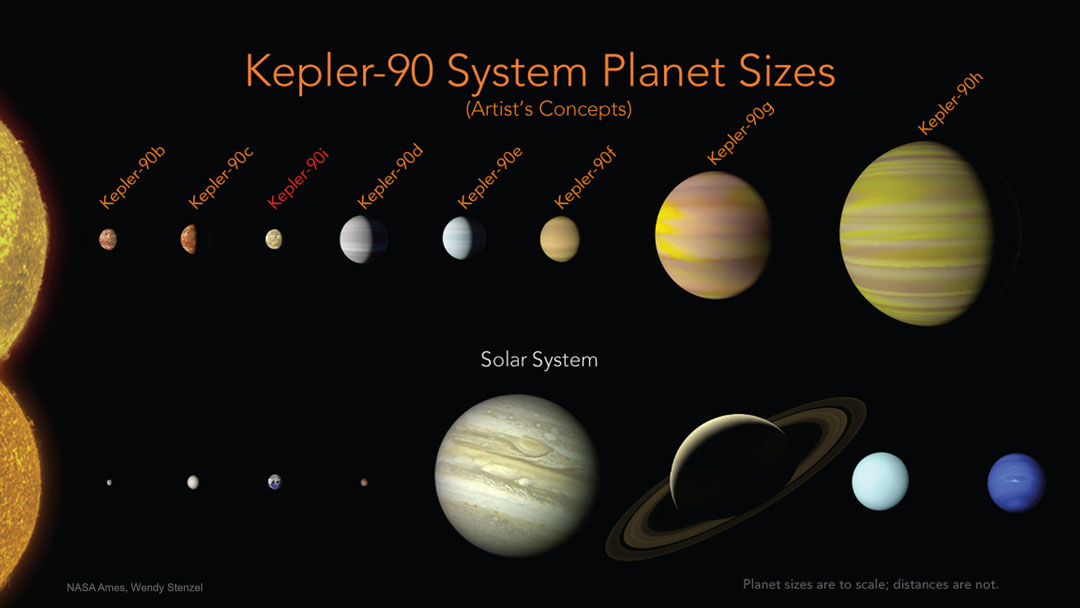
Do other stars have planetary systems like our own? Yes -- one such system is Kepler-90. Cataloged by the orbiting Kepler satellite, an eighth planet has now been discovered giving Kepler-90 the same number of known planets as our Solar System. Similarities between Kepler-90 and our system include a G-type star comparable to our Sun, rocky planets comparable to our Earth, and large planets comparable in size to Jupiter and Saturn. Differences include that all of the known Kepler-90 planets orbit relatively close in -- closer than Earth's orbit around the Sun -- making them possibly too hot to harbor life. However, observations over longer time periods may discover cooler planets further out. Kepler-90 lies about 2,500 light years away, and at magnitude 14 is visible with a medium-sized telescope toward the constellation of the Dragon (Draco). Exoplanet-finding missions planned for launch in the next decade include TESS, JWST, WFIRST, and PLATO.