Saturn
The sixth planet from the Sun, known for its stunning ring system composed of ice particles, rock debris, and dust. Saturn is the second-largest planet in the Solar System and is visible to the naked eye under dark skies.
Source: solarsystem.nasa.gov
APODs including "Saturn"
Highlights of the North Autumn Sky
25/09/2018
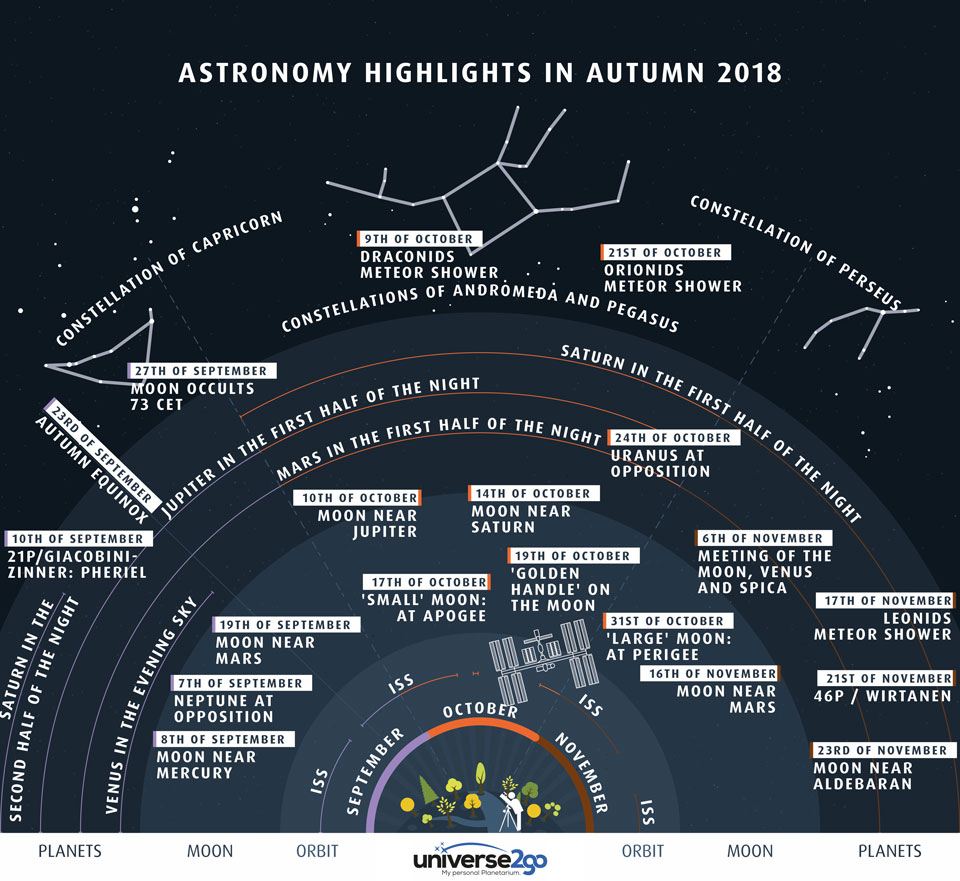
What can you see in the night sky this season? The featured graphic gives a few highlights for Earth's northern hemisphere. Viewed as a clock face centered at the bottom, early (northern) autumn sky events fan out toward the left, while late autumn events are projected toward the right. Objects relatively close to Earth are illustrated, in general, as nearer to the cartoon figure with the telescope at the bottom center -- although almost everything pictured can be seen without a telescope. As happens during any season, constellations appear the same year to year, and, as usual, the Leonids meteor shower will peak in mid-November. Also as usual, the International Space Station (ISS) can be seen, at times, as a bright spot drifting across the sky after sunset. Planets visible after sunset this autumn include Jupiter and Mars, and during late autumn, Saturn.