Saturn
The sixth planet from the Sun, known for its stunning ring system composed of ice particles, rock debris, and dust. Saturn is the second-largest planet in the Solar System and is visible to the naked eye under dark skies.
Source: solarsystem.nasa.gov
APODs including "Saturn"
Crescent Saturn
07/07/2019
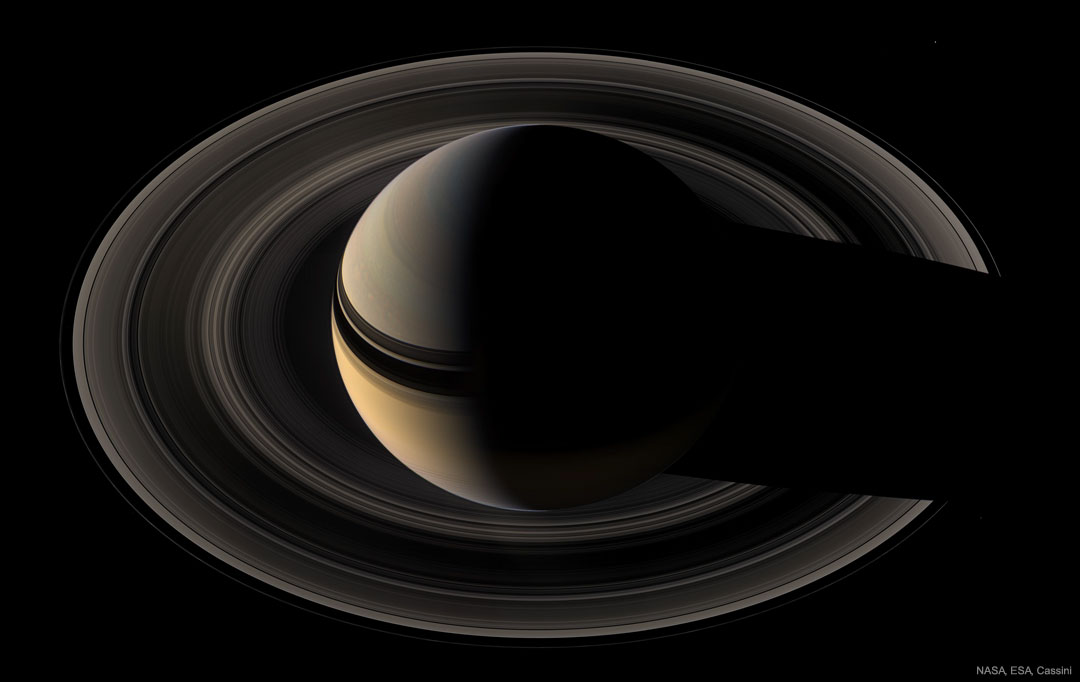
Saturn never shows a crescent phase -- from Earth. But when viewed from beyond, the majestic giant planet can show an unfamiliar diminutive sliver. This image of crescent Saturn in natural color was taken by the robotic Cassini spacecraft in 2007. The featured image captures Saturn's majestic rings from the side of the ring plane opposite the Sun -- the unilluminated side -- another vista not visible from Earth. Pictured are many of Saturn's photogenic wonders, including the subtle colors of cloud bands, the complex shadows of the rings on the planet, and the shadow of the planet on the rings. A careful eye will find the moons Mimas (2 o'clock) and Janus (4 o'clock), but the real challenge is to find Pandora (8 o'clock). Saturn is now nearly opposite from the Sun in the Earth's sky and so can be seen in the evening starting just after sunset for the rest of the night.