Seagull Nebula
The Seagull Nebula (IC 2177) is an extensive emission and reflection nebula in the constellation Monoceros, spanning roughly 200–240 light‑years. Illuminated by embedded massive stars—such as HD 53367 at its head—it forms a shape resembling a seagull in flight and lies about 3,800 light‑years from Earth.
Source: nasa.gov
APODs including "Seagull Nebula"
The Seagull Nebula
13/03/2024
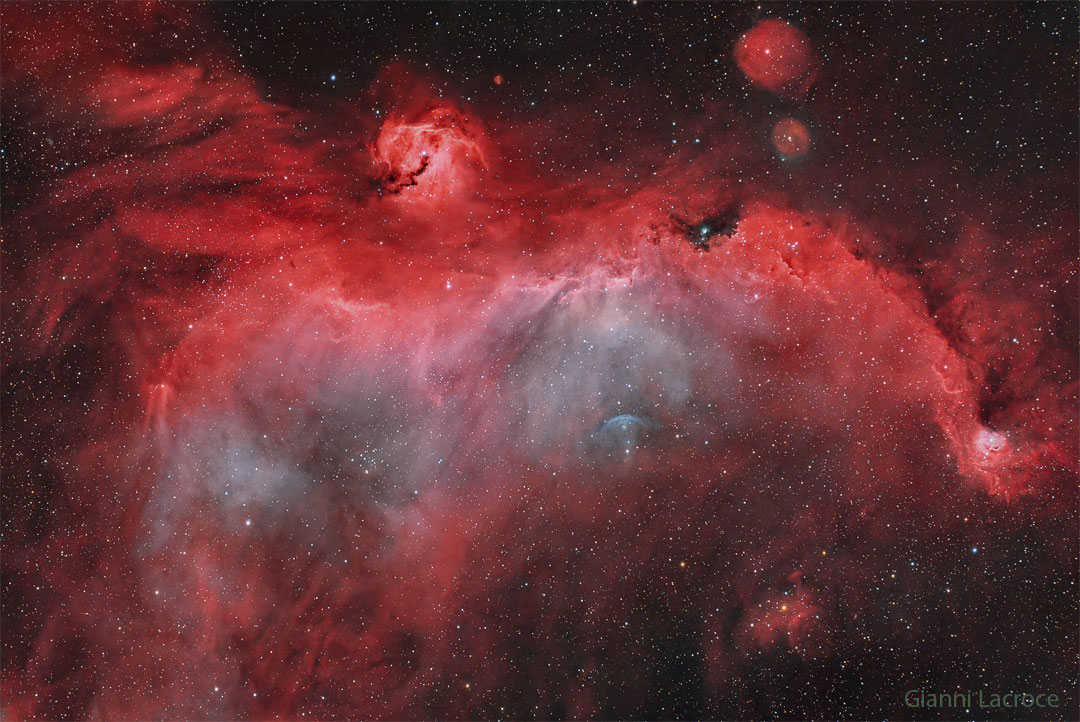
A broad expanse of glowing gas and dust presents a bird-like visage to astronomers from planet Earth, suggesting its popular moniker: the Seagull Nebula. This portrait of the cosmic bird covers a 2.5-degree wide swath across the plane of the Milky Way, near the direction of Sirius, alpha star of the constellation of the Big Dog (Canis Major). Of course, the region includes objects with other catalog designations: notably NGC 2327, a compact, dusty emission and reflection nebula with an embedded massive star that forms the bird's head. Likely part of a larger shell structure swept up by successive supernova explosions, the broad Seagull Nebula is cataloged as Sh2-296 and IC 2177. The prominent bluish arc below and right of center is a bow shock from runaway star FN Canis Majoris. Dominated by the reddish glow of atomic hydrogen, this complex of gas and dust clouds with other stars of the Canis Majoris OB1 association spans over 200 light-years at the Seagull Nebula's estimated 3,800 light-year distance. Almost Hyperspace: Random APOD Generator