Shangri-La
A large, dark equatorial region on Titan characterized by extensive longitudinal dune fields composed of hydrocarbon particles. It was imaged by the Cassini spacecraft using radar and infrared instruments.
Source
APODs including "Shangri-La"
The Gum Nebula over Snowy Mountains
27 June 2022
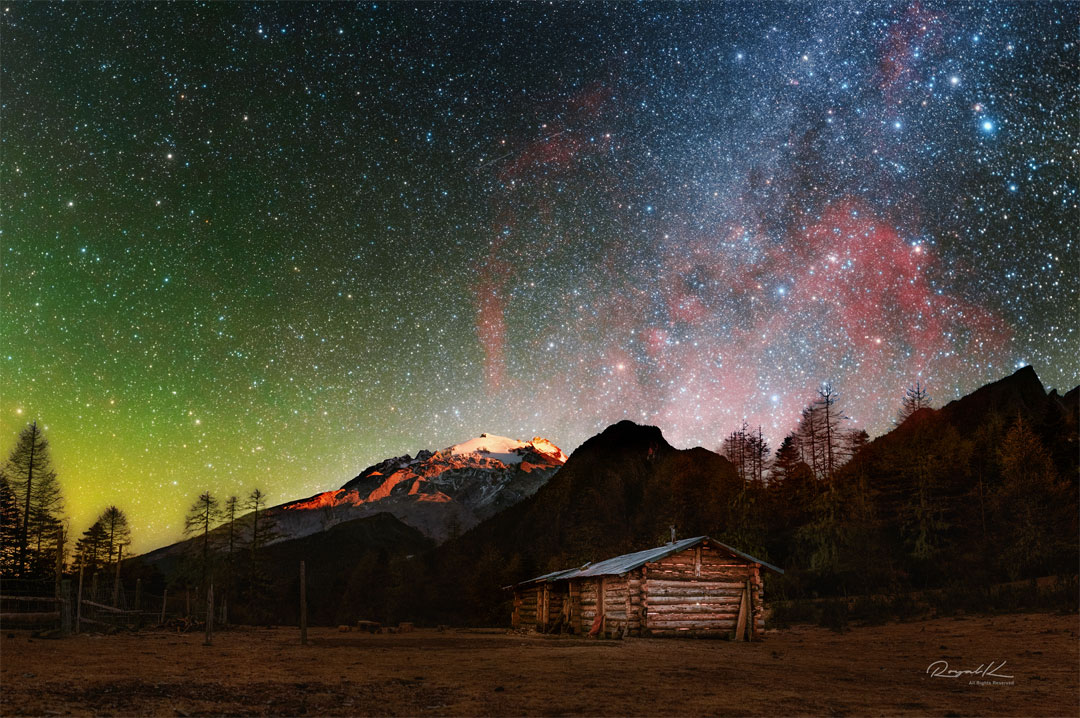
The Gum Nebula is so large and close it is actually hard to see. This interstellar expanse of glowing hydrogen gas frequently evades notice because it spans 35 degrees -- over 70 full Moons -- while much of it is quite dim. This featured spectacular 90-degree wide mosaic, however, was designed to be both wide and deep enough to bring up the Gum -- visible in red on the right. The image was acquired late last year with both the foreground -- including Haba Snow Mountain -- and the background -- including the Milky Way's central band -- captured by the same camera and from the same location in Shangri-La, Yunnan, China. The Gum Nebula is so close that we are only about 450 light-years from the front edge, while about 1,500 light-years from the back edge. Named for a cosmic cloud hunter, Australian astronomer Colin Stanley Gum (1924-1960), the origin of this complex nebula is still being debated. A leading theory for the origin of the Gum Nebula is that it is the remnant of a million year-old supernova explosion, while a competing theory holds that the Gum is a molecular cloud shaped over eons by multiple supernovas and the outflowing winds of several massive stars.