Small Magellanic Cloud
A dwarf irregular galaxy that is a satellite of the Milky Way, situated about 210,000 light-years away in the constellation Tucana. The SMC is characterized by its low metallicity and active star-forming regions like NGC 346.
Source
APODs including "Small Magellanic Cloud"
Wonder and Mystery above the Very Large Telescopes
9 May 2011
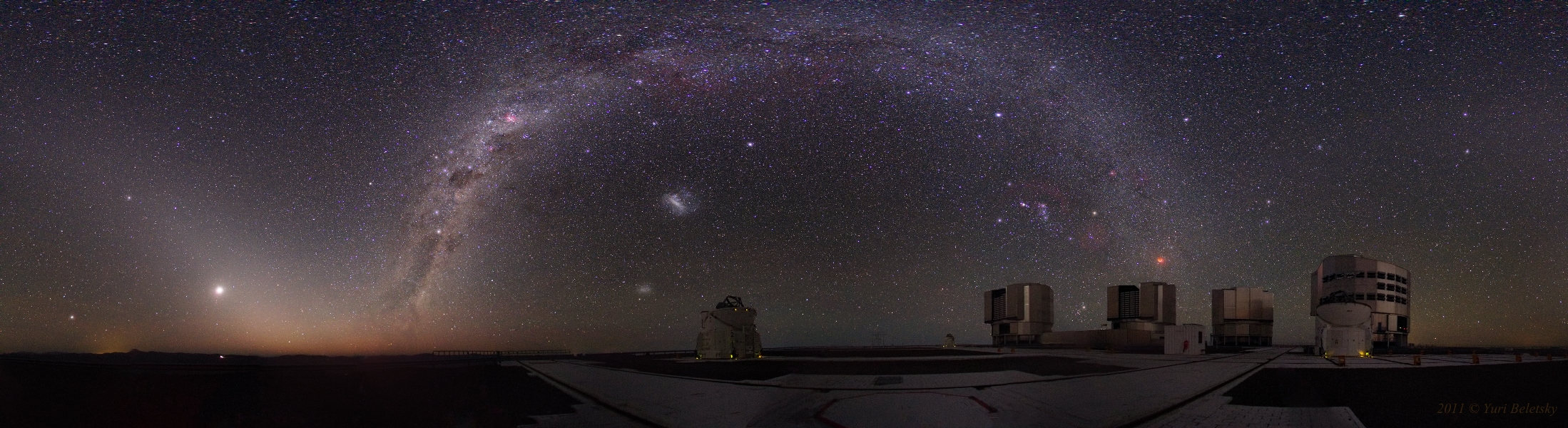
What's that bright orange dot above the large telescope on the right? Even seasoned sky enthusiasts might ponder the origin of the orange orb seen by scrolling across this panoramic image, taken last December. Perhaps identifying known objects will help. To start, on the far left is a diagonal band of light known as zodiacal light, sunlight reflected off of dust orbiting in the inner Solar System. The bright white spot on the left, just above the horizon, is Venus, which also glows by reflected sunlight. Rising diagonally from the ground to the right of Venus is the band of our Milky Way Galaxy. In the image, the band, which usually stretches dramatically overhead, appears to arch above the elevated Chilean landscape. Under the Milky Way arch, toward the left, lie both the Large and Small Magellanic Cloud galaxies, while toward the right lies the constellation of Orion surrounded by the red ring of Barnard's Loop. On the ground, each of the four Very Large Telescopes is busy keeping an eye on the distant universe. The orange spot -- it's the Moon. The image was taken during a total lunar eclipse when the normally bright full moon turned into a faint orb tinted orange by the intervening Earth's atmosphere.