Small Magellanic Cloud
A dwarf irregular galaxy that is a satellite of the Milky Way, situated about 210,000 light-years away in the constellation Tucana. The SMC is characterized by its low metallicity and active star-forming regions like NGC 346.
Source
APODs including "Small Magellanic Cloud"
Three Galaxies over New Zealand
11 June 2014
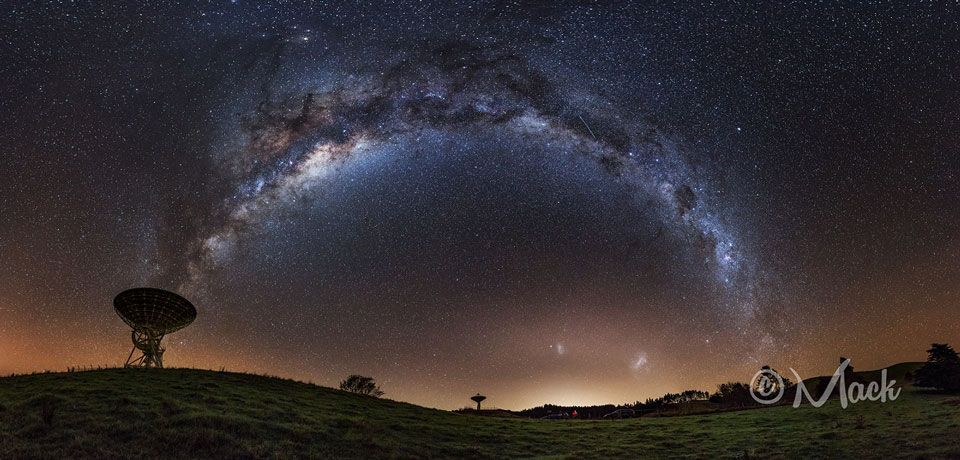
No, radio dishes cannot broadcast galaxies. Although they can detect them, the above image features a photogenic superposition during a dark night in New Zealand about two weeks ago. As pictured above, the central part of our Milky Way Galaxy is seen rising to the east on the image left and arching high overhead. Beneath the Galactic arc and just above the horizon are the two brightest satellite galaxies of our Milky Way, with the Small Magellanic Cloud to the left and the Large Magellanic Cloud on the right. The radio dish is the Warkworth Satellite Station located just north of Auckland.