Small Magellanic Cloud
A dwarf irregular galaxy that is a satellite of the Milky Way, situated about 210,000 light-years away in the constellation Tucana. The SMC is characterized by its low metallicity and active star-forming regions like NGC 346.
Source
APODs including "Small Magellanic Cloud"
NGC 602 in the Flying Lizard Nebula
7 March 2015
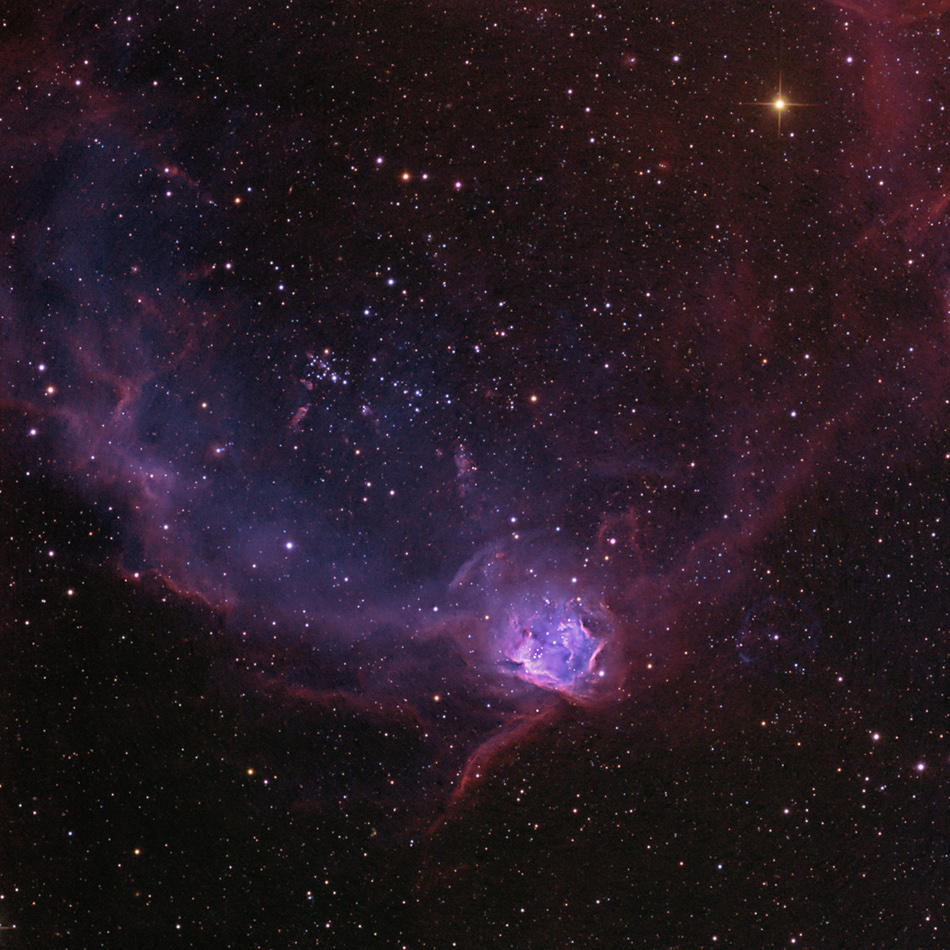
Near the outskirts of the Small Magellanic Cloud, a satellite galaxy some 200 thousand light-years distant, lies 5 million year young star cluster NGC 602. Surrounded by natal gas and dust, NGC 602 is just below center in this telescopic field of view with the angular size of the Full Moon on the sky. The cluster itself is about 200 light-years in diameter. Glowing interior ridges and swept back shapes strongly suggest that energetic radiation and shock waves from NGC 602's massive young stars have eroded the dusty material and triggered a progression of star formation moving away from the cluster's center. Of course, the more extended wings of emission in the region suggest a popular name for the complex cosmic environment, The Flying Lizard Nebula.