Small Magellanic Cloud
A dwarf irregular galaxy that is a satellite of the Milky Way, situated about 210,000 light-years away in the constellation Tucana. The SMC is characterized by its low metallicity and active star-forming regions like NGC 346.
Source
APODs including "Small Magellanic Cloud"
Milky Way Over Quiver Tree Forest
15 May 2016
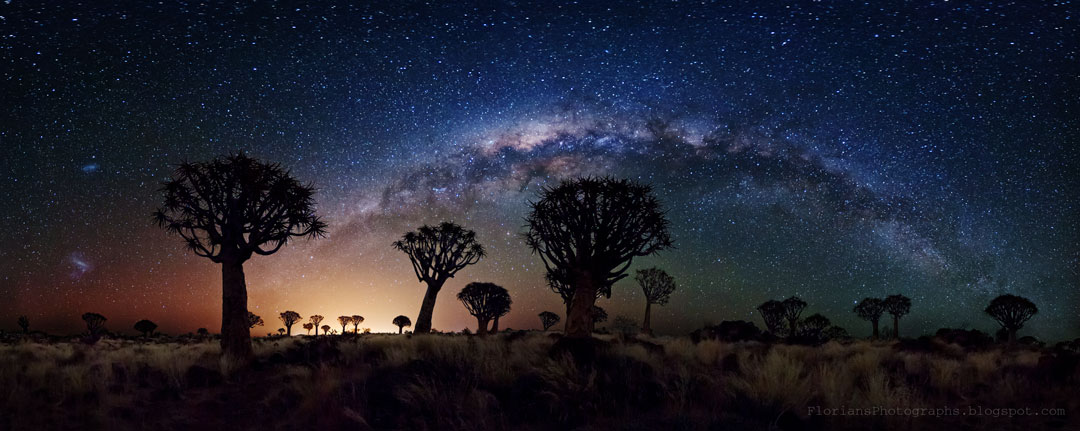
In front of a famous background of stars and galaxies lies some of Earth's more unusual trees. Known as quiver trees, they are actually succulent aloe plants that can grow to tree-like proportions. The quiver tree name is derived from the historical usefulness of their hollowed branches as dart holders. Occurring primarily in southern Africa, the trees pictured in the above 16-exposure composite are in Quiver Tree Forest located in southern Namibia. Some of the tallest quiver trees in the park are estimated to be about 300 years old. Behind the trees is light from the small town of Keetmanshoop, Namibia. Far in the distance, arching across the background, is the majestic central band of our Milky Way Galaxy. Even further in the distance, visible on the image left, are the Large and Small Magellanic Clouds, smaller satellite galaxies of the Milky Way that are prominent in the skies of Earth's southern hemisphere.