Small Magellanic Cloud
A dwarf irregular galaxy that is a satellite of the Milky Way, situated about 210,000 light-years away in the constellation Tucana. The SMC is characterized by its low metallicity and active star-forming regions like NGC 346.
Source
APODs including "Small Magellanic Cloud"
Magellanic Mountain
28 April 2018
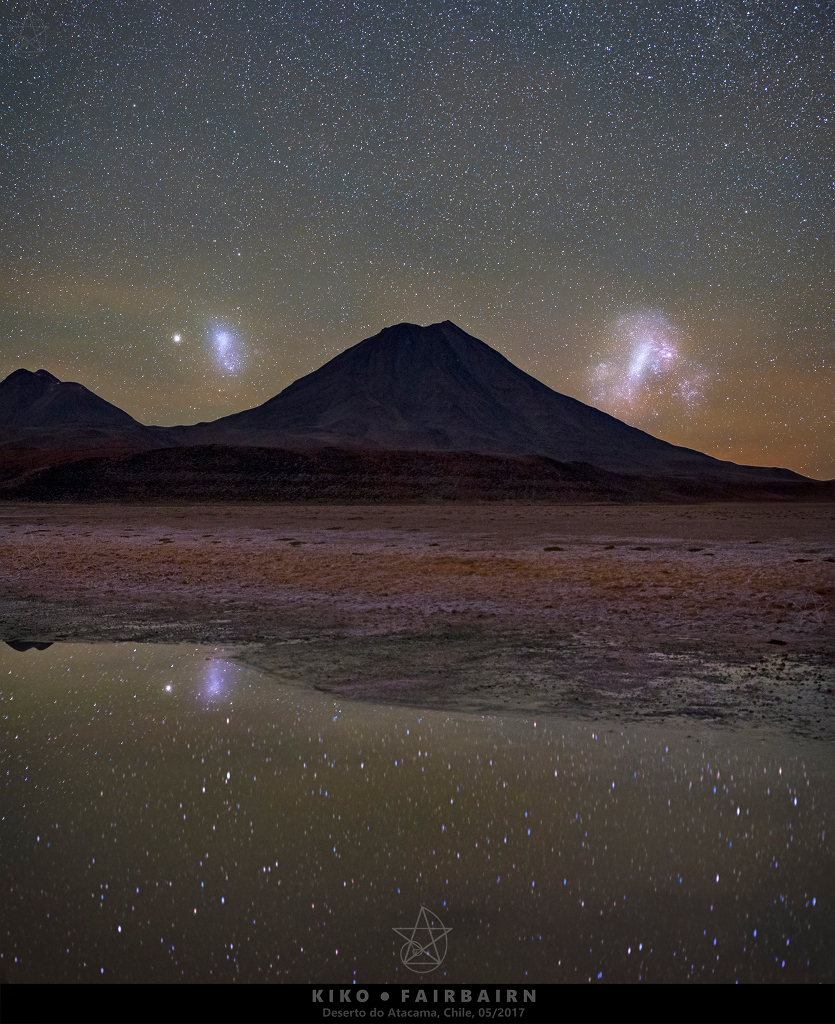
Flanked by satellite galaxies of the Milky Way a volcanic peak rises from this rugged horizon. The southern night skyscape looks toward the south over Laguna Lejia and the altiplano of the Antofagasta Region of northern Chile. Extending the view across extragalactic space, the Large (right) and Small Magellanic Clouds are so named for the 16th century Portuguese explorer Ferdinand Magellan, leader of planet Earth's first circumnavigation. The larger cloud lies some 180,000 light-years, and the smaller 210,000 light-years beyond the mountaintop. Left of the Small Cloud of Magellan and also reflected in the foreground watery shallows on that starry night, 47 Tucanae shines like a bright star. A globular star cluster that roams the halo of the Milky Way, 47 Tucanae is about 13,000 light-years away.