Spiral Arms
Regions of stars and interstellar matter that extend from the center of spiral galaxies, forming a spiral pattern; in the Milky Way, these include the Orion Arm where our Solar System resides.
Source
APODs including "Spiral Arms"
Starburst Galaxy Messier 94
23 October 2015
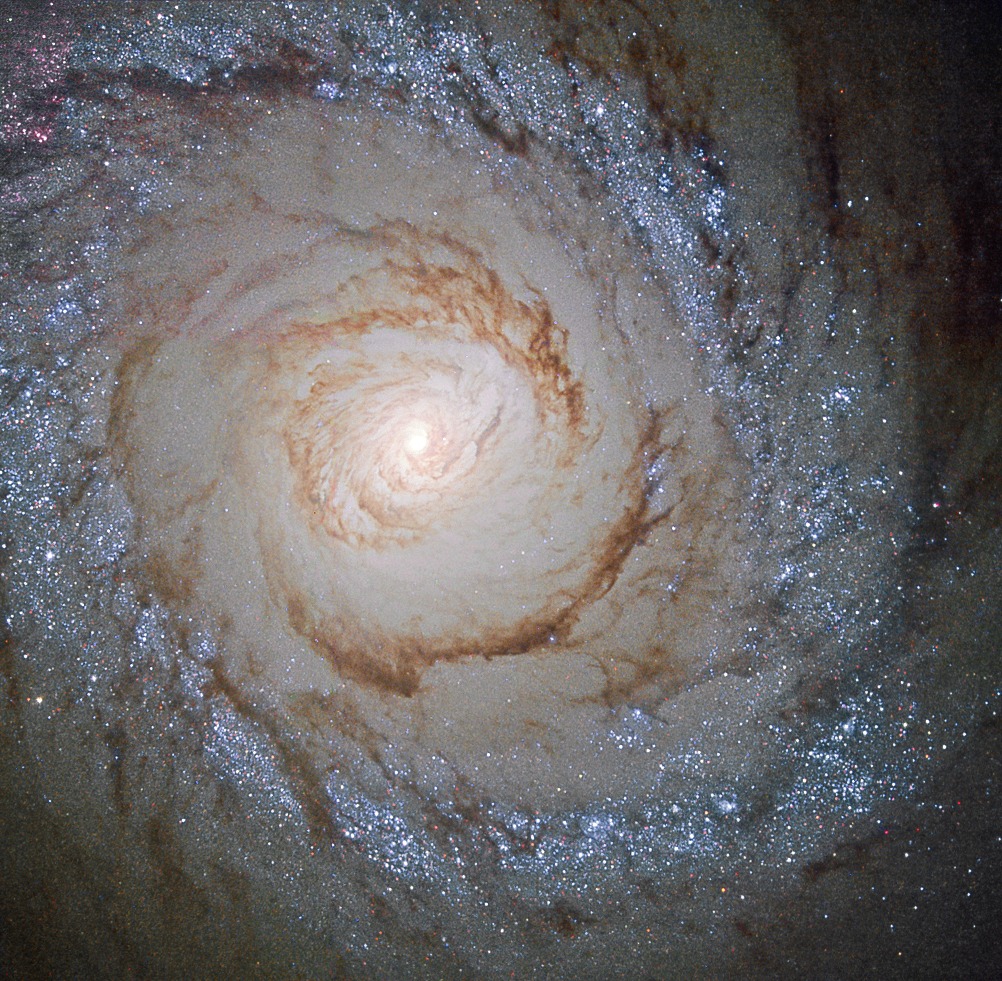
Beautiful island universe Messier 94 lies a mere 15 million light-years distant in the northern constellation of the hunting dogs, Canes Venatici. A popular target for earth-based astronomers, the face-on spiral galaxy is about 30,000 light-years across, with spiral arms sweeping through the outskirts of its broad disk. But this Hubble Space Telescope field of view spans about 7,000 light-years or so across M94's central region. The sharp close-up examines the galaxy's compact, bright nucleus and prominent inner dust lanes, surrounded by a remarkable bluish ring of young, massive stars. The massive stars in the ring are all likely less than 10 million years old, indicating the galaxy experienced a well-defined era of rapid star formation. As a result, while the small, bright nucleus is typical of the Seyfert class of active galaxies, M94 is also known as a starburst galaxy. Because M94 is relatively nearby, astronomers can explore in detail reasons for the galaxy's burst of star formation.