Spiral Arms
Regions of stars and interstellar matter that extend from the center of spiral galaxies, forming a spiral pattern; in the Milky Way, these include the Orion Arm where our Solar System resides.
Source: esa.int
APODs including "Spiral Arms"
M31: The Andromeda Galaxy
22/03/2023
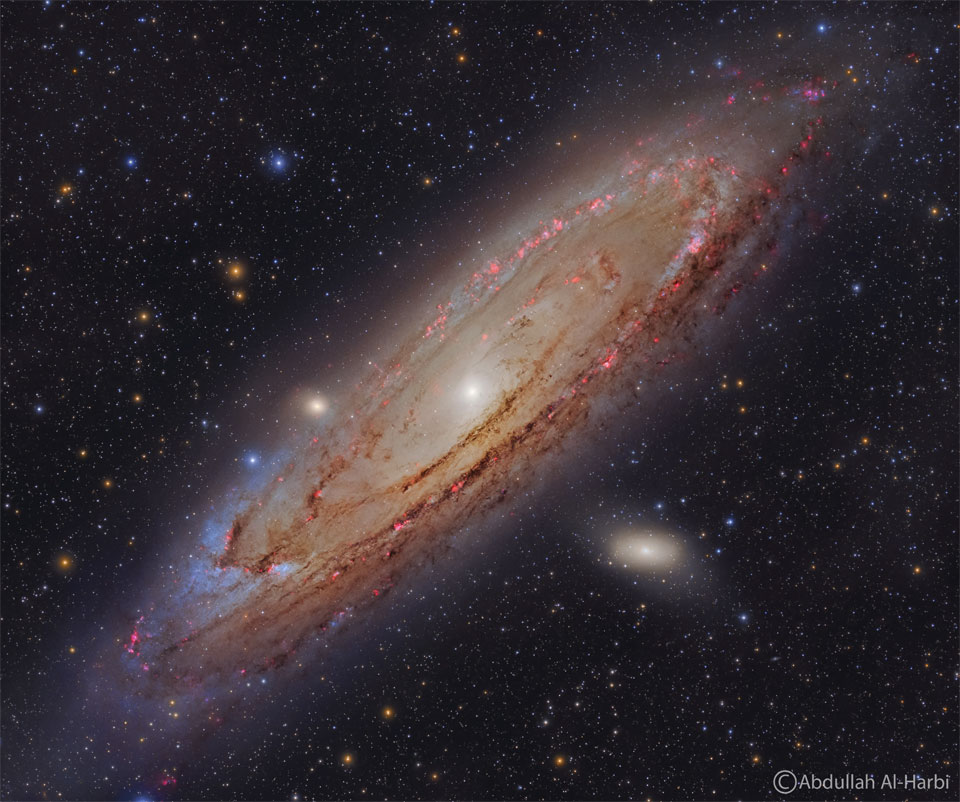
How far can you see? The most distant object easily visible to the unaided eye is M31, the great Andromeda Galaxy, over two million light-years away. Without a telescope, even this immense spiral galaxy appears as an unremarkable, faint, nebulous cloud in the constellation Andromeda. But a bright white nucleus, dark winding dust lanes, luminous blue spiral arms, and bright red emission nebulas are recorded in this stunning fifteen-hour telescopic digital mosaic of our closest major galactic neighbor. But how do we know this spiral nebula is really so far away? This question was central to the famous Shapley-Curtis debate of 1920. M31's great distance was determined in the 1920s by observations that resolved individual stars that changed their brightness in a way that gave up their true distance. The result proved that Andromeda is just like our Milky Way Galaxy -- a conclusion making the rest of the universe much more vast than had ever been previously imagined.