Spitzer Space Telescope
The Spitzer Space Telescope was an infrared space observatory launched by NASA in 2003, which operated until 2020, providing insights into the early universe, exoplanets, and more.
Source: jpl.nasa.gov
APODs including "Spitzer Space Telescope"
GLIMPSE the Milky Way
16/12/2005
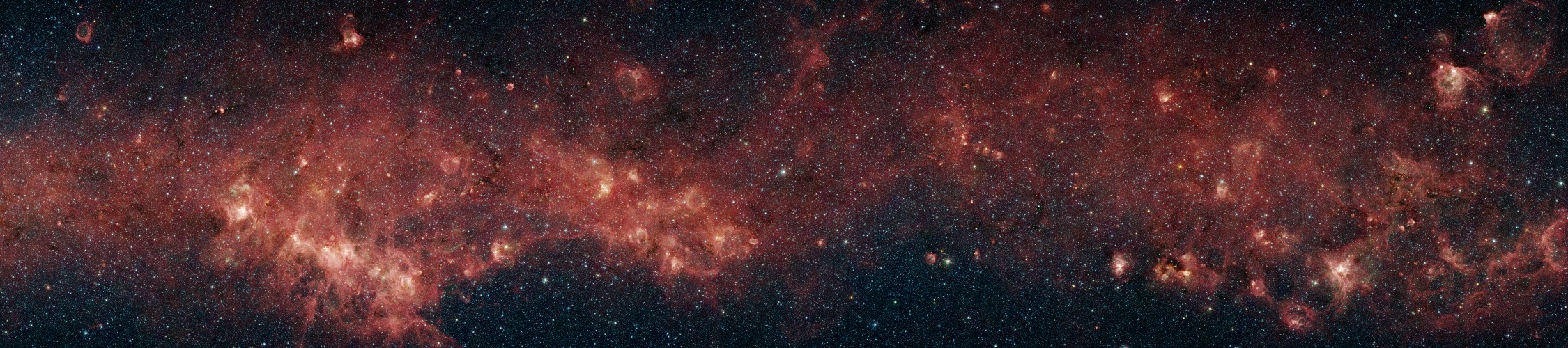
Scroll right and gaze through the dusty plane of our Milky Way Galaxy in infrared light. The cosmic panorama is courtesy of the Galactic Legacy Infrared Mid-Plane Survey Extraordinaire (GLIMPSE) project and the Spitzer Space Telescope. The galactic plane itself runs through the middle of the false-color view that spans nine degrees (about 18 full moons) across the southern constellation Norma. Spitzer's infrared cameras see through much of the galaxy's obscuring dust revealing many new star clusters as well as star forming regions (bright white splotches) and hot interstellar hydrogen gas (greenish wisps). The pervasive red clouds are emission from dust and organic molecules, pocked with holes and bubbles blown by energetic outflows from massive stars. Intensely dark patches are regions of dust too dense for even Spitzer's infrared vision to penetrate.