Sputnik Planum
A vast, icy plain on Pluto's surface, informally named after Earth's first artificial satellite, Sputnik. Characterized by its smooth, craterless terrain, it is believed to be composed primarily of nitrogen ice and exhibits signs of recent geological activity.
Source: nasa.gov
APODs including "Sputnik Planum"
Sputnik Planum vs. Krun Macula
18/06/2016
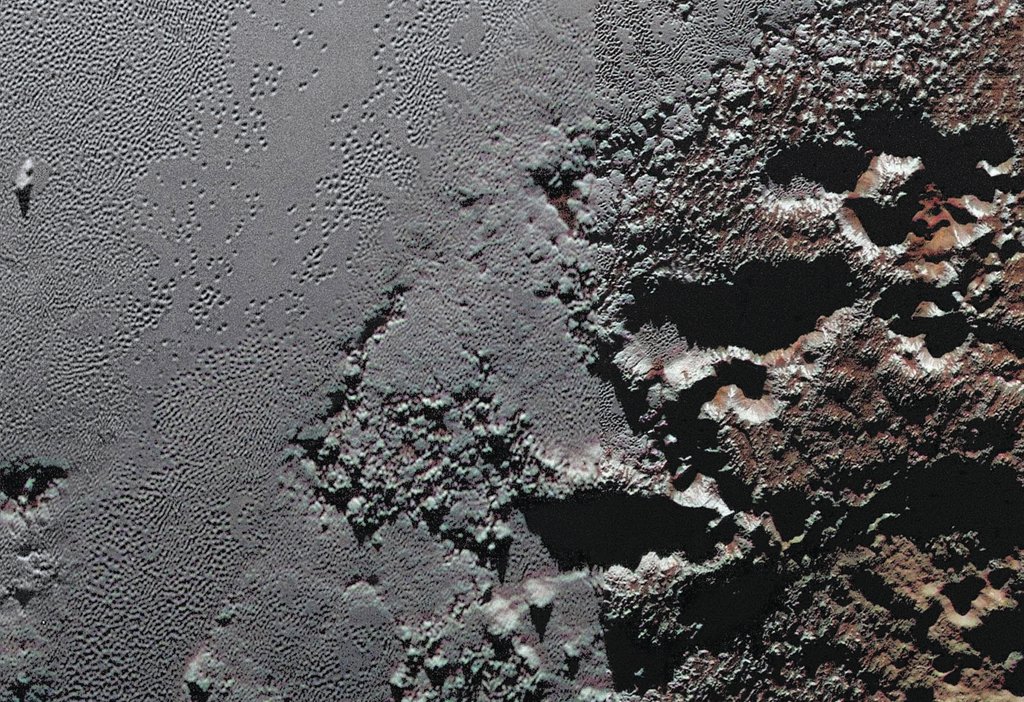
Pluto's pitted plains meet rugged highlands in this stunning view. On the left lies a southeastern extent of the bright region still informally known as Sputnik Planum. At right the edge of a dark region, informally Krun Macula, rises some 2.5 kilometers above the icy plains. Along the boundary, connected clusters of large pits form deep valleys, some over 40 kilometers long with shadowy floors. Nitrogen ice is likely responsible for the more reflective plains. The dark red color of the highlands is thought to be from complex compounds called tholins, a product of ultraviolet light induced chemical reactions with methane in Pluto's atmosphere. The enhanced color image includes portions of the highest and second highest resolution image data from the New Horizons July 2015 flyby of the distant world.