Star
A star is a massive, self-luminous sphere of plasma held together by its own gravity. It shines by converting hydrogen into helium through nuclear fusion in its core, releasing energy across the electromagnetic spectrum.
Stars form in large clouds of gas and dust—called nebulae—where regions collapse under gravity, creating protostars. When core temperatures reach millions of degrees, fusion ignites, marking the birth of a star. Observatories like Hubble and missions such as NASA’s Infrared telescopes have imaged this process in action.
The majority (~90%) of stars are main-sequence stars, fusing hydrogen into helium. These include a broad range of masses—from red dwarfs (small, long-lived, faint) to blue giants and supergiants (massive, hot, and short-lived). Our Sun is a middle-aged G-type main sequence star.
As stars exhaust their hydrogen fuel, their evolution depends on mass. Lower-mass stars become red giants then white dwarfs. More massive stars undergo successive fusion stages, end in supernova explosions, and leave behind neutron stars or black holes.
Stars vary in brightness, size, and color. They are classified using spectral types (O, B, A, F, G, K, M) based on surface temperature and absorption lines. For example, O- and B-type stars are hot and blue; M-type are cool and red.
Stellar remnants include white dwarfs (Earth-sized cores of former stars), neutron stars (city-sized remnants of supernovae), and black holes (extreme-density objects from the most massive stars).
Stars are not static—many rotate, exhibit magnetic activity (like sunspots and flares), and broadcast stellar winds. Their lifecycle enriches the interstellar medium with heavier elements, seeding future generations of stars and planets.
Stars often exist in groups—binary or systems within star clusters and galaxies. Their properties are studied via brightness, spectra, parallax, variability, and statistical surveys by missions like Gaia and Kepler.
Sources
APODs including "Star"
Chasing the ISS
4 June 2008
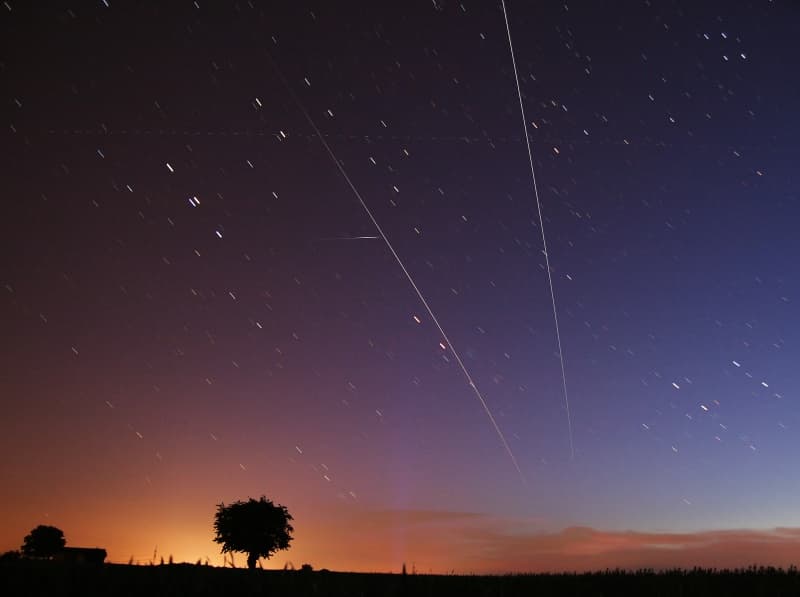
Bathed in sunlight, the International Space Station (ISS) arced through the evening sky above the town of Lauffen in southern Germany on May 31st. The timing of the bright passage was about 10 minutes after the launch of the Space Shuttle Discovery on the STS-124 mission from Kennedy Space Center, Florida, in the southeastern US. Of course, Discovery was headed toward an orbital rendezvous with the ISS. In chasing after the space station, the shuttle also made a pass over Lauffen just 21 minutes after launch. With a camera fixed to a tripod, astronomer Jürgen Michelberger recorded both magnificent machines streaking overhead in two different time exposures, each about 2 minutes long, and merged them in this composite view. Parallax causes the paths of the ISS (right) and Discovery (near center) to seem to diverge as they were at very different altitudes. Stars (and bright planets) leave two, separated, short trails. The brief, flaring track of an Iridium satellite and faint dotted trail of a passing airplane are also visible. A close inspection will reveal a dim reddish track, the jettisoned external fuel tank, just left of Discovery. Placing your cursor over the picture should help identify some of the features.