Star
A star is a massive, self-luminous sphere of plasma held together by its own gravity. It shines by converting hydrogen into helium through nuclear fusion in its core, releasing energy across the electromagnetic spectrum.
Stars form in large clouds of gas and dust—called nebulae—where regions collapse under gravity, creating protostars. When core temperatures reach millions of degrees, fusion ignites, marking the birth of a star. Observatories like Hubble and missions such as NASA’s Infrared telescopes have imaged this process in action.
The majority (~90%) of stars are main-sequence stars, fusing hydrogen into helium. These include a broad range of masses—from red dwarfs (small, long-lived, faint) to blue giants and supergiants (massive, hot, and short-lived). Our Sun is a middle-aged G-type main sequence star.
As stars exhaust their hydrogen fuel, their evolution depends on mass. Lower-mass stars become red giants then white dwarfs. More massive stars undergo successive fusion stages, end in supernova explosions, and leave behind neutron stars or black holes.
Stars vary in brightness, size, and color. They are classified using spectral types (O, B, A, F, G, K, M) based on surface temperature and absorption lines. For example, O- and B-type stars are hot and blue; M-type are cool and red.
Stellar remnants include white dwarfs (Earth-sized cores of former stars), neutron stars (city-sized remnants of supernovae), and black holes (extreme-density objects from the most massive stars).
Stars are not static—many rotate, exhibit magnetic activity (like sunspots and flares), and broadcast stellar winds. Their lifecycle enriches the interstellar medium with heavier elements, seeding future generations of stars and planets.
Stars often exist in groups—binary or systems within star clusters and galaxies. Their properties are studied via brightness, spectra, parallax, variability, and statistical surveys by missions like Gaia and Kepler.
Sources
APODs including "Star"
HH-222: The Waterfall Nebula
24 October 2011
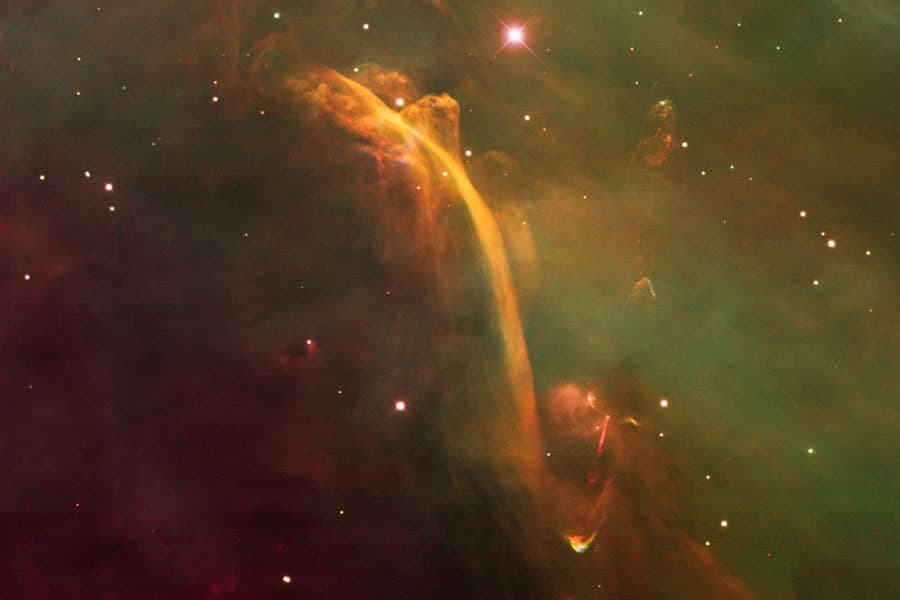
What created the Waterfall Nebula? No one knows. The structure seen in the region of NGC 1999 in the Great Orion Molecular Cloud complex is one of the more mysterious structures yet found on the sky. Designated HH-222, the elongated gaseous stream stretches about ten light years and emits an unusual array of colors. One hypothesis is that the gas filament results from the wind from a young star impacting a nearby molecular cloud. That would not explain, however, why the Waterfall and fainter streams all appear to converge on a bright but unusual non thermal radio source located toward the upper left of the curving structure. Another hypothesis is that the unusual radio source originates from a binary system containing a hot white dwarf, neutron star, or black hole, and that the Waterfall is just a jet from this energetic system. Such systems, though, are typically strong X-rays emitters, and no X-rays have been detected. For now, this case remains unsolved. Perhaps well-chosen future observations and clever deductive reasoning will unlock the true origin of this enigmatic wisp in the future. Astronomers: What other "mysterious structures" appear on the sky?