Star
A star is a massive, self-luminous sphere of plasma held together by its own gravity. It shines by converting hydrogen into helium through nuclear fusion in its core, releasing energy across the electromagnetic spectrum.
Stars form in large clouds of gas and dust—called nebulae—where regions collapse under gravity, creating protostars. When core temperatures reach millions of degrees, fusion ignites, marking the birth of a star. Observatories like Hubble and missions such as NASA’s Infrared telescopes have imaged this process in action.
The majority (~90%) of stars are main-sequence stars, fusing hydrogen into helium. These include a broad range of masses—from red dwarfs (small, long-lived, faint) to blue giants and supergiants (massive, hot, and short-lived). Our Sun is a middle-aged G-type main sequence star.
As stars exhaust their hydrogen fuel, their evolution depends on mass. Lower-mass stars become red giants then white dwarfs. More massive stars undergo successive fusion stages, end in supernova explosions, and leave behind neutron stars or black holes.
Stars vary in brightness, size, and color. They are classified using spectral types (O, B, A, F, G, K, M) based on surface temperature and absorption lines. For example, O- and B-type stars are hot and blue; M-type are cool and red.
Stellar remnants include white dwarfs (Earth-sized cores of former stars), neutron stars (city-sized remnants of supernovae), and black holes (extreme-density objects from the most massive stars).
Stars are not static—many rotate, exhibit magnetic activity (like sunspots and flares), and broadcast stellar winds. Their lifecycle enriches the interstellar medium with heavier elements, seeding future generations of stars and planets.
Stars often exist in groups—binary or systems within star clusters and galaxies. Their properties are studied via brightness, spectra, parallax, variability, and statistical surveys by missions like Gaia and Kepler.
Sources
APODs including "Star"
A Trip to the Moon
13 January 2014
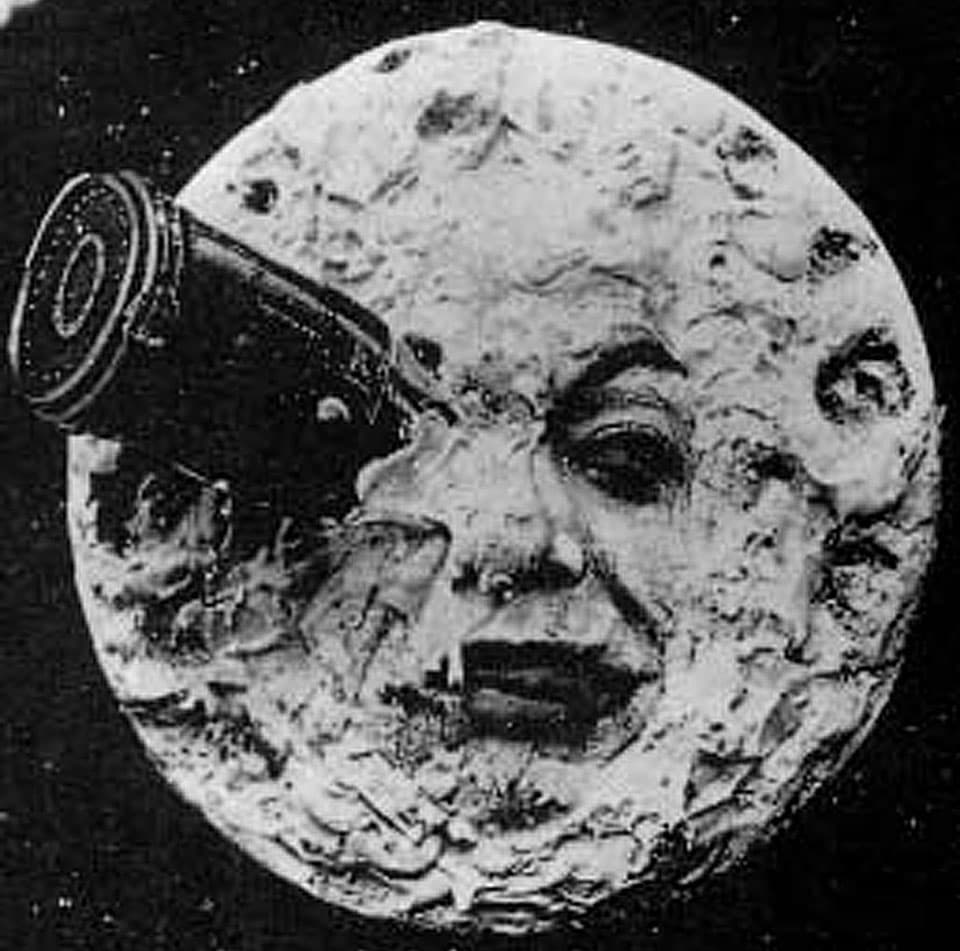
What would it be like to visit the Moon? The first major fictional cinematic film exploring this enduring transcultural fantasy was titled Le voyage dans la lune (A Trip to the Moon) and made in 1902, becoming one of the most popular movies of the early years of the twentieth century. The silent film starred the filmmaker Georges Melies himself and portrayed a club of astronomers voyaging to the Moon and back. Pictured above is a frame from the movie that has become an enduring icon for both film and space. Alluding to a bullseye trajectory, the Man in the Moon is caricatured as being struck by the human-built spaceship. The entire 14-minute film is now freely available. Visiting the Moon remained a very popular topic even 67 years later in 1969 when humans first made an actual voyage.