Star
A star is a massive, self-luminous sphere of plasma held together by its own gravity. It shines by converting hydrogen into helium through nuclear fusion in its core, releasing energy across the electromagnetic spectrum.
Stars form in large clouds of gas and dust—called nebulae—where regions collapse under gravity, creating protostars. When core temperatures reach millions of degrees, fusion ignites, marking the birth of a star. Observatories like Hubble and missions such as NASA’s Infrared telescopes have imaged this process in action.
The majority (~90%) of stars are main-sequence stars, fusing hydrogen into helium. These include a broad range of masses—from red dwarfs (small, long-lived, faint) to blue giants and supergiants (massive, hot, and short-lived). Our Sun is a middle-aged G-type main sequence star.
As stars exhaust their hydrogen fuel, their evolution depends on mass. Lower-mass stars become red giants then white dwarfs. More massive stars undergo successive fusion stages, end in supernova explosions, and leave behind neutron stars or black holes.
Stars vary in brightness, size, and color. They are classified using spectral types (O, B, A, F, G, K, M) based on surface temperature and absorption lines. For example, O- and B-type stars are hot and blue; M-type are cool and red.
Stellar remnants include white dwarfs (Earth-sized cores of former stars), neutron stars (city-sized remnants of supernovae), and black holes (extreme-density objects from the most massive stars).
Stars are not static—many rotate, exhibit magnetic activity (like sunspots and flares), and broadcast stellar winds. Their lifecycle enriches the interstellar medium with heavier elements, seeding future generations of stars and planets.
Stars often exist in groups—binary or systems within star clusters and galaxies. Their properties are studied via brightness, spectra, parallax, variability, and statistical surveys by missions like Gaia and Kepler.
Sources
APODs including "Star"
Heart and Soul and Double Cluster
24 September 2016
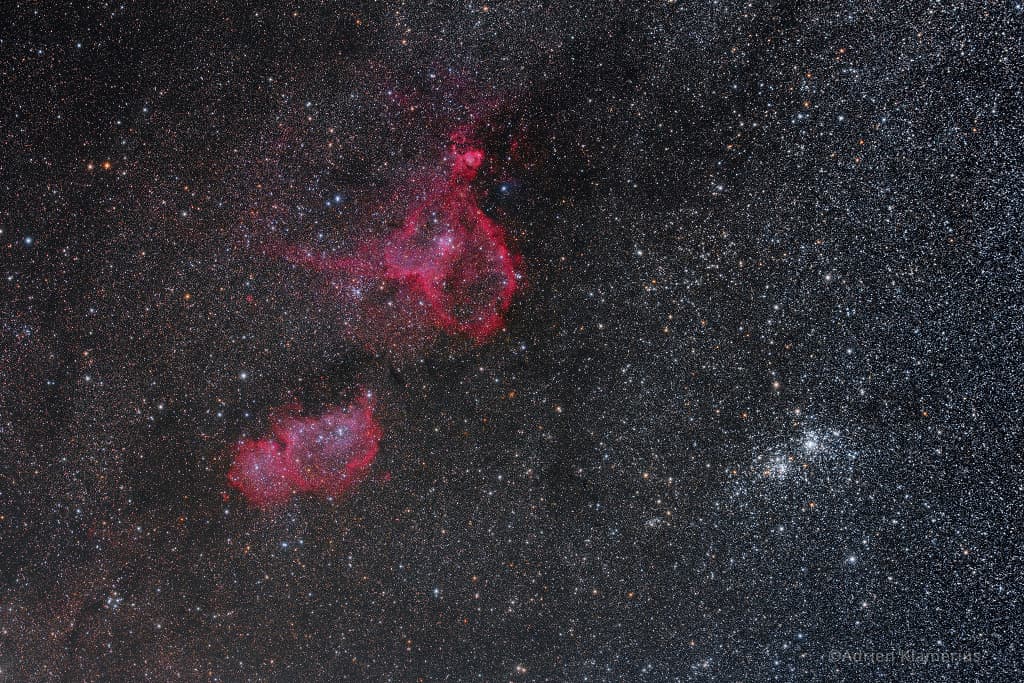
This rich starfield spans almost 10 degrees across the sky toward the northern constellations Cassiopeia and Perseus. On the left, heart-shaped cosmic cloud IC 1805 and IC 1848 are popularly known as the Heart and Soul nebulae. Easy to spot on the right are star clusters NGC 869 and NGC 884 also known as h and Chi Perseii, or just the Double Cluster. Heart and Soul, with their own embedded clusters of young stars a million or so years old, are each over 200 light-years across and 6 to 7 thousand light-years away. In fact, they are part of a large, active star forming complex sprawling along the Perseus spiral arm of our Milky Way Galaxy. The Double Cluster is located at about the same distance as the Heart and Soul nebulae. Separated by only a few hundred light-years, h and Chi Perseii are physically close together, and both clusters are estimated to be about 13 million years old. Their proximity and similar stellar ages suggest both clusters are likely a product of the same star-forming region.