Supermassive Black Hole
A black hole with a mass ranging from millions to billions of times that of the Sun, typically found at the centers of galaxies. These black holes influence the dynamics and evolution of their host galaxies.
Source: nasa.gov
APODs including "Supermassive Black Hole"
A Milestone Quasar
18/08/1996
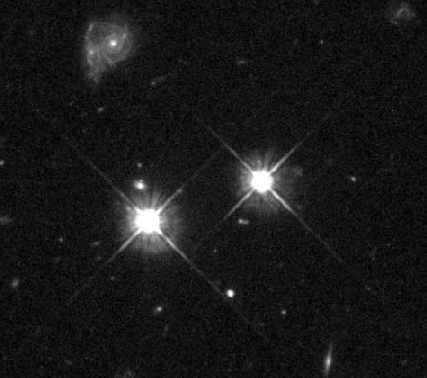
Here is a rather typical quasar. But since quasars are so unusual it is quite atypical of most familiar objects. Of the two bright objects in the center of this photo, the quasar is on the left. The bright image to quasar's right is a star, the faint object just above the quasar is an elliptical galaxy, with an apparently interacting pair of spiral galaxies near the top. Quasars appear as unresolved points of light, as do stars, and hence quasars were thought to be a type of star until the 1960s. We now know that the brightest quasars lie far across the visible universe from us, and include the most distant objects known. Quasars may occupy the centers of galaxies and may even be much brighter than their host galaxies. In fact, the centers of many nearby galaxies have similarities to quasars - including the center of our own Milky Way Galaxy. The exact mechanism responsible for a quasar's extreme brightness is unknown, but thought to involve supermassive black holes. This picture represents a milestone for the six-year-old Hubble Space Telescope as it was picture number 100,000, taken on June 22, 1996.