Supermassive Black Hole
A black hole with a mass ranging from millions to billions of times that of the Sun, typically found at the centers of galaxies. These black holes influence the dynamics and evolution of their host galaxies.
Source: nasa.gov
APODs including "Supermassive Black Hole"
X-rays From The Perseus Cluster Core
15/06/2000
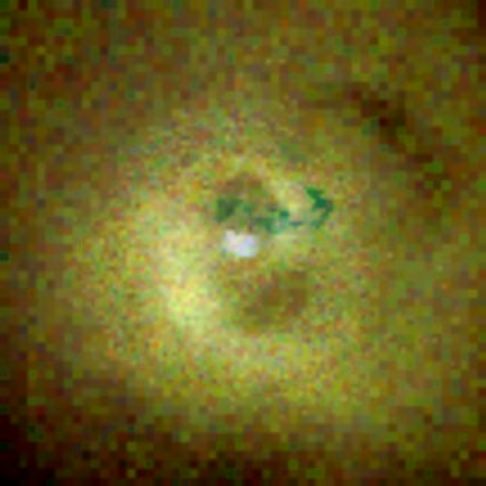
The Perseus Cluster of thousands of galaxies, 320 million light-years distant, is one of the most massive objects in the Universe. At its core lies the giant cannibal galaxy Perseus A (NGC 1275), accreting matter as gas and galaxies fall into it. Representing low, medium, and high energy x-rays as red, green, and blue colours respectively, this Chandra X-ray Observatory image shows remarkable details of x-ray emission from this monster galaxy and surrounding hot (30-70 million degrees C) cluster gas. The bright central source is the supermassive black hole at the core of Perseus A itself. Dark circular voids just above and below the galaxy center, each about half the size of our own Milky Way Galaxy, are believed to be magnetic bubbles of energetic particles blown by the accreting black hole. Settling toward Perseus A, the cluster's x-ray hot gas piles up forming bright regions around the bubble rims. Dramatically, the long greenish wisp just above the galaxy's centre is likely the x-ray shadow produced by a small galaxy falling into the burgeoning Perseus A.