Supermassive Black Hole
A black hole with a mass ranging from millions to billions of times that of the Sun, typically found at the centers of galaxies. These black holes influence the dynamics and evolution of their host galaxies.
Source: nasa.gov
APODs including "Supermassive Black Hole"
NGC 253: X-Ray Zoom
07/06/2001
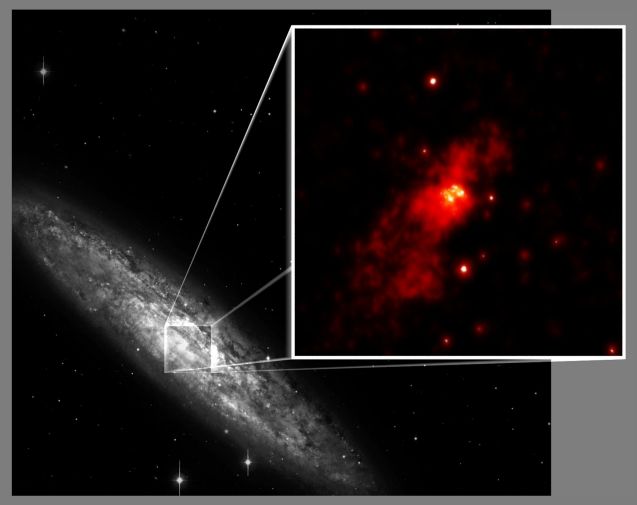
Astronomers now report that Chandra X-ray Observatory observations of galaxies known to be frantically forming stars show that these galaxies also contain luminous x-ray sources -- thought to be intermediate mass black holes and immense clouds of superheated gas. Take the lovely island universe NGC 253 for example. At distance of a mere 8 million light-years, NGC 253's prodigious starforming activity has been well studied using high-resolution optical images like the one seen here at lower left. Zooming in on this energetic galaxy's central region, Chandra's x-ray detectors reveal hidden details indicated in the inset at right. In the false-color image, x-ray hot gas clouds glow near the core and at least four very powerful x-ray sources lie within 3,000 light-years of the center of the galaxy. Much more luminous than black hole binary star systems in our own galaxy, these extreme x-ray sources may be gravitating toward NGC 253's center. As a result, NGC 253 and other similar starforming galaxies could ultimately develop a single, central, supermassive black hole, transforming their cores into quasars.